
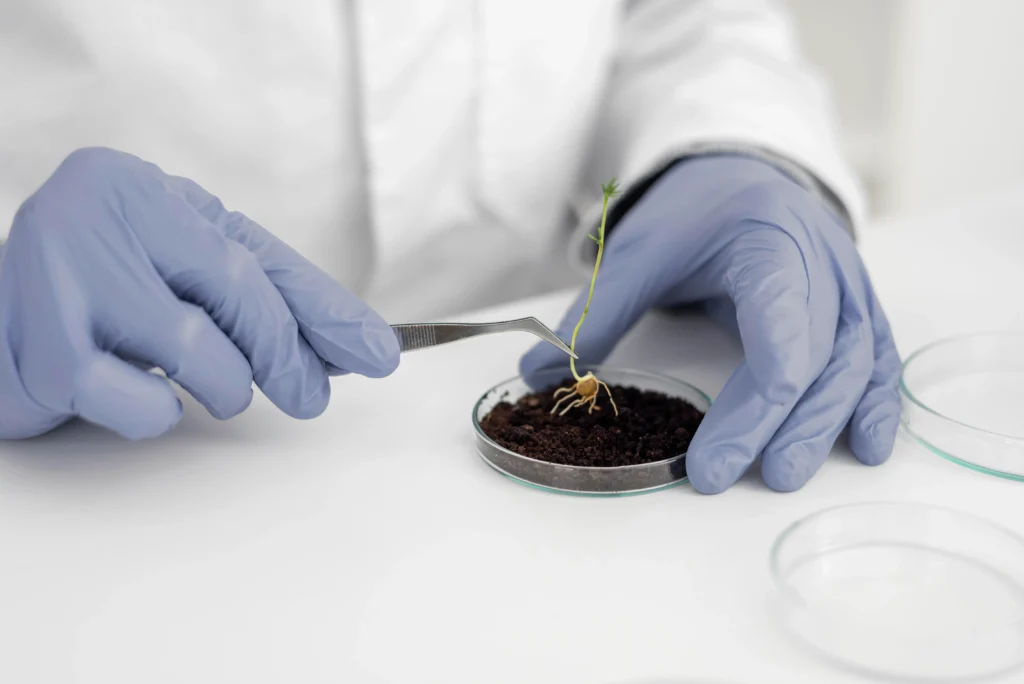

SGM National Laboratory is based in Udaipur, Rajasthan, and provides soil testing services for clients across Chennai and Tamil Nadu through secure sample collection and courier submission. As a Soil Testing Laboratory in Chennai, we support clients who need fertility data before a planting season, geotechnical results before a foundation design, or contamination screening for an environmental study. We test your sample using the same instruments, methods, and reporting standards we use for every client, regardless of where the sample was collected.
Soil quality directly influences plant growth, agricultural productivity, construction stability, and environmental safety. At our Soil Testing Laboratory in Chennai, we provide accurate and reliable soil testing services for farmers, construction companies, researchers, developers, exporters, and quality control teams. We evaluate important parameters such as pH, N-P-K, organic matter, electrical conductivity, moisture content, soil texture, bearing capacity, and heavy metal content. Our detailed testing reports help clients understand soil composition, identify potential issues, select suitable treatments, support construction planning, comply with relevant standards, and make informed decisions for agriculture, landscaping, infrastructure, and environmental applications.
SGM National Laboratory provides reliable Soil Testing Services in Chennai for agriculture, construction, environmental assessment, research, and industrial applications. Our laboratory evaluates key soil properties such as pH, electrical conductivity, nutrients, organic matter, moisture, density, texture, grain size, heavy metals, strength, and compaction. We use appropriate laboratory testing methods to generate accurate and consistent results. Detailed, easy-to-understand reports help farmers, builders, contractors, researchers, and businesses assess soil quality, plan effectively, verify specifications, identify potential issues, and make informed decisions for agricultural management, construction projects, environmental evaluation, and quality control.

Evaluating essential nutrients and fertility indicators to understand soil productivity and nutrient availability. Results help farmers and land managers plan suitable crops, improve fertilizer use, and maintain soil health over time.

Analyzing major and micronutrients in soil to determine their concentration and availability. Testing helps identify nutrient deficiencies, assess soil balance, and support informed fertilizer planning and agricultural management decisions.

Measuring soil pH and electrical conductivity to determine acidity, alkalinity, and soluble salt levels. Results help assess soil conditions and suitability for agriculture, landscaping, cultivation, and other specified applications.

Measuring organic carbon and organic matter to evaluate important soil health indicators. Testing provides useful information about fertility, nutrient cycling, soil quality, and the overall condition of soil for agricultural management.

Testing soil for specified heavy metals and contaminants that may affect agricultural or environmental use. Results help identify potential contamination levels and support site assessment, monitoring, remediation planning, and land-use decisions.

Determining soil moisture content and density to understand important physical characteristics. These results support agricultural assessment, compaction studies, material evaluation, construction planning, and soil quality control requirements.

Evaluating important engineering properties such as grain size, density, shear strength, and other specified characteristics. Testing supports foundation assessment, construction planning, earthwork evaluation, and site suitability studies.

Assessing soil strength and compaction characteristics to understand how soil behaves under applied loads. Testing supports foundation planning, pavement projects, earthwork control, construction quality, and site suitability assessment.

Determining the proportions and distribution of sand, silt, and clay particles to classify soil texture and understand its physical behaviour. Results support agricultural planning, drainage assessment, construction studies, and soil evaluation.

Soil testing helps determine the chemical, physical, and nutritional properties that influence soil quality and its suitability for agriculture, landscaping, and construction. At SGM National Laboratory, we provide Soil Testing Services in Chennai by analyzing soil samples for important parameters such as pH, N-P-K, organic matter, electrical conductivity, moisture content, soil texture, and heavy metals. Our testing process uses suitable laboratory methods to generate accurate and reliable results. Detailed reports help farmers, developers, construction companies, researchers, and environmental teams assess soil conditions, plan suitable treatments, support project decisions, and maintain consistent soil quality.
Tell us your soil type, intended application, and testing purpose. Whether you need testing for agriculture, construction, environmental assessment, or research, we help identify the appropriate parameters for analysis.
Collect a representative soil sample using the recommended sampling procedure. Our team can guide you on suitable collection methods, sample quantity, handling, and packaging to help maintain sample condition before testing.
Pack the collected soil sample securely as per our guidelines and send it to our laboratory in Udaipur through a reliable courier. Proper packaging helps protect the sample from contamination and unnecessary changes during transit.
Once your sample reaches our laboratory, we record the sample details and prepare it according to the selected testing requirements. Proper sample preparation helps maintain consistency and supports accurate and reliable soil analysis.
Our technical team tests the soil sample using appropriate laboratory methods and instruments based on the required parameters. Results are carefully reviewed for accuracy and consistency before the final report is prepared.
Receive a detailed soil testing report containing the tested parameters, results, units, and relevant testing details. The report can support agricultural planning, construction projects, environmental assessment, research, and quality control.
Soil testing goes beyond a single fertility score. At SGM National Laboratory, our Soil Testing Laboratory in Chennai looks at the physical, chemical, and structural properties that determine how land performs — whether that’s for a crop, a foundation, or an environmental assessment. This supports agricultural planning, construction site evaluation, and land-use decisions across industries. We evaluate key soil characteristics, including:
| Parameter | Why It Matters |
|---|---|
| pH Level | Determines soil acidity or alkalinity, which affects nutrient availability and suitability for specific crops. |
| Nutrient Content (N-P-K) | Measures nitrogen, phosphorus, and potassium levels, guiding fertilizer application and crop planning. |
| Organic Matter | Indicates soil fertility and structure, influencing water retention and long-term soil health. |
| Electrical Conductivity | Measures soluble salt content, relevant to plant growth and irrigation water suitability. |
| Moisture Content | Affects soil workability, compaction behaviour, and construction site suitability. |
| Soil Texture | Determines the proportion of sand, silt, and clay, influencing drainage and load-bearing capacity. |
| Bearing Capacity | Assesses how much load soil can support, critical for foundation and structural design. |
| Heavy Metal Content | Screens for contamination relevant to agricultural safety and environmental compliance. |

Soil fertility and nutrient testing provide valuable data on pH, organic matter, and nutrient availability. These results help farmers and agricultural professionals select suitable crops, plan fertilizer applications, and improve soil productivity.

Soil fertility and nutrient testing provide data on pH, organic matter, and nutrient availability. These results help farmers select suitable crops, plan fertilizer applications, improve soil productivity, and manage agricultural land effectively.

Soil testing supports road and infrastructure projects by evaluating bearing capacity, density, moisture, grain size, and compaction. Reliable soil data helps engineers understand ground conditions and plan suitable pavements, foundations, and earthworks.

Soil analysis helps identify contaminants and evaluate soil composition during environmental assessments. Testing parameters heavy metals, pH, organic matter, and moisture supports evaluation, monitoring, and environmental management.

Soil fertility, pH, moisture, and nutrient testing helps determine whether soil is suitable for plants and landscaping. Results guide soil amendments, fertilizer selection, plant choices, and better management of growing conditions for healthy plant growth.

Soil characterization provides valuable information for industrial site planning and development. Testing physical, chemical, and geotechnical properties helps businesses understand ground conditions and support project design, site evaluation, and planning.

Soil testing helps evaluate ground conditions for residential, commercial, and industrial construction. Testing moisture, density, grain size, strength, and compaction provides useful data for foundation design, earthwork, and construction planning.

Soil testing supports mining and quarrying projects by evaluating soil composition, moisture, density, physical properties, and specified contaminants. Results assist site characterization, land assessment, environmental monitoring, and project planning.

Soil testing provides reliable analytical data for research, laboratory studies, and academic projects. Testing can cover chemical, physical, nutrient, and geotechnical properties to support soil characterization, experiments, and scientific evaluation.

Soil pH indicates whether soil is acidic, neutral, or alkaline. It directly affects nutrient availability and plant growth. Testing helps determine whether the soil conditions are suitable for a particular crop and whether amendments may be required.
NPK testing measures the levels of three essential nutrients required for healthy plant growth. Results help identify nutrient deficiencies or excesses, allowing farmers to plan fertilizer applications based on actual soil conditions.
Organic matter contributes to soil structure, moisture retention, nutrient cycling, and biological activity. Testing helps assess overall soil health and provides useful information for managing fertility and maintaining productive agricultural land over time.
Electrical conductivity indicates the concentration of soluble salts present in soil. Higher EC levels may indicate salinity conditions that can affect plant growth and nutrient uptake, making EC testing useful for agricultural soil assessment and management.
Soil texture describes the proportions of sand, silt, and clay. These characteristics influence drainage, water retention, compaction, stability, and load-bearing behaviour, providing useful information for foundation planning and construction site evaluation.
Bearing capacity indicates how much load soil can safely support without excessive shear failure or settlement. This information is important for engineers when evaluating foundation requirements and selecting an appropriate foundation design for a construction project.
Yes. Soil testing can analyze specified heavy metals and other contaminants that may affect agricultural land, groundwater, or environmental safety. Results help identify potential contamination levels and support site assessment, monitoring, and management decisions.
Soil moisture affects important physical properties such as density, compaction, consistency, and strength. In agricultural applications, moisture also influences nutrient availability. Measuring moisture content provides useful context for interpreting soil characteristics and test results.
Soil fertility testing focuses on agricultural parameters such as pH, nutrients, organic matter, and salinity. Geotechnical testing evaluates engineering properties such as strength, density, compaction, and grain size for construction applications.
Soil retesting frequency depends on crop type, fertilizer use, soil conditions, irrigation, and land management practices. Periodic testing helps track changes in nutrient levels and pH, allowing farmers to adjust fertilizer and soil management practices accordingly.
Yes. Soil testing can identify issues such as nutrient deficiencies, unsuitable pH, high salinity, or low organic matter that may affect crop performance. Results provide useful information for investigating soil-related causes and planning corrective measures.
The required sampling depth depends on the purpose of testing and the type of assessment being performed. Agricultural and geotechnical sampling may require different depths, so the appropriate depth should be selected based on the testing objective.
Yes. Soil compaction testing is important for roads, buildings, pavements, embankments, and other infrastructure projects. It helps evaluate whether soil has achieved suitable density and compaction characteristics for supporting expected loads and construction requirements.
The number of samples depends on the size, layout, soil variability, and purpose of testing. Multiple samples from representative locations can provide a more reliable assessment than relying on a single sample from the entire field or site.
Yes. Soil testing
can provide information about chemical composition, heavy metals, salinity, organic matter, and other specified parameters. These results can support environmental site assessments, contamination screening, monitoring, and evaluation before development or land-use changes.
High salinity should be evaluated based on the soil test results, crop requirements, irrigation practices, and site conditions. The results can help guide appropriate soil and water management strategies, including suitable amendments or irrigation adjustments where applicable.