
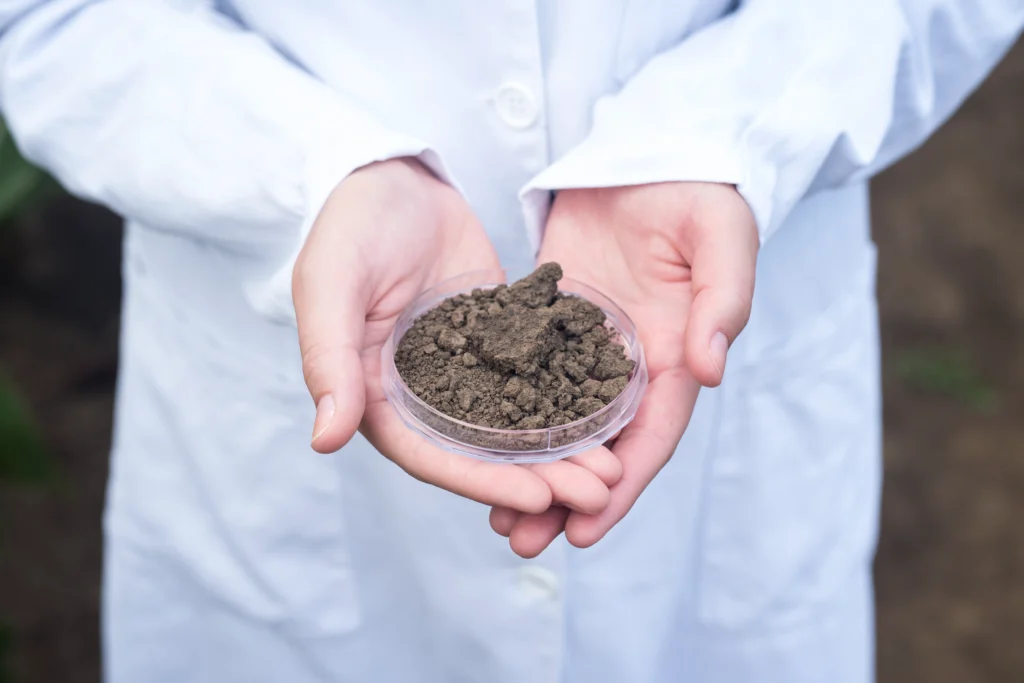

Soil Testing Laboratory in India
If you've ever wondered why one field yields a bumper crop while the one next to it struggles, the answer is usually buried — literally — in the soil. SGM National Laboratory runs a full-service Soil Testing Lab in India, helping farmers, builders, industries, and researchers understand exactly what's happening beneath their feet before they make expensive decisions.
We test soil for agriculture, construction, mining, environmental compliance, and academic research. Whether you're trying to figure out why your yield dropped, checking if a plot is safe to build on, or screening land for contamination, our lab gives you numbers you can actually act on — pH, moisture, nutrient levels, texture, heavy metals, and more, depending on what your project needs.
Why Bother Testing Soil in the First Place?
Soil doesn’t announce its problems. A field can look perfectly healthy and still be low on nitrogen, running an unusual pH, or carrying heavy metals from years of industrial runoff nearby. None of that shows up to the naked eye — you need a lab to catch it. That’s really the whole point of soil testing: it replaces guesswork with data. Farmers use it to stop over-fertilizing (which wastes money and can hurt the soil long-term). Builders use it to know how a foundation will behave before pouring concrete. Environmental consultants use it to catch contamination before it becomes a legal or health problem. At SGM National Laboratory, we shape each test around what our client actually needs to know — not a generic, one-size-fits-all package.
Soil Testing Services in India
SGM National Laboratory provides reliable Soil Testing Services in India for agriculture, construction, mining, environmental assessment, industrial development, land management, and research applications. Our Soil Testing Laboratory in India evaluates key physical, chemical, elemental, and geotechnical properties using appropriate testing methods. We provide clear and detailed reports to help farmers, industries, consultants, researchers, and organizations understand soil characteristics and make informed decisions for soil management, site assessment, environmental evaluation, construction planning, and project development. Our testing scope can be customized based on sample characteristics and specific project requirements.

Soil Fertility Testing
We evaluate key fertility indicators such as pH, organic matter, electrical conductivity, and essential nutrients. Results help assess soil productivity, identify deficiencies, plan fertilizer applications, and support better crop and land management decisions.

Soil pH Testing
Soil pH determines whether the soil is acidic, neutral, or alkaline and directly affects nutrient availability. Testing helps identify unsuitable pH conditions and supports decisions about appropriate soil amendments and crop suitability.

Soil Nutrient Testing
We test essential nutrients such as nitrogen, phosphorus, potassium, calcium, magnesium, and sulphur. Results help identify nutrient deficiencies or excesses and support informed fertilizer planning based on soil and crop requirements.

Soil Moisture Testing
Soil moisture testing determines the amount of water present in a sample. Results are useful for irrigation planning, agricultural assessment, compaction studies, construction activities, and understanding how moisture influences soil behaviour.

Soil Texture Analysis
We analyze the proportions of sand, silt, and clay to determine soil texture. This information helps assess drainage, water retention, compaction, nutrient behaviour, and suitability for agricultural, landscaping, and construction applications.

Particle Size Analysis of Soil
Particle size analysis determines the distribution of soil particles in a sample. The results support soil classification, construction studies, geotechnical assessments, material characterization, and research particle distribution data.

Soil Contamination Testing
Soil contamination testing helps identify potentially harmful substances associated with industrial activities, pesticides, mining, waste, or other site-specific sources. Results support environmental assessment, site evaluation, monitoring, and informed land-use decisions.

Heavy Metal Testing in Soil
We can test soil for specified heavy metals such as lead, arsenic, cadmium, chromium, mercury, nickel, copper, and zinc. Testing helps assess potential contamination more accurately and supports environmental studies, industrial site assessments, and land evaluation.

Soil Composition Analysis
Soil composition analysis provides a broader understanding of the chemical and elemental characteristics of a sample. It helps evaluate soil quality, identify major constituents, compare samples, and support agricultural, environmental, construction, and research applications.

How We Actually Test It
The appropriate soil testing method depends on the parameter, sample characteristics, intended application, and testing requirements. SGM National Laboratory provides reliable Soil Testing Services in India and operates as a trusted Soil Testing Lab in India, using suitable laboratory procedures to evaluate selected physical, chemical, and elemental properties for agricultural, environmental, construction, industrial, mining, and research applications.
pH Analysis
We use calibrated laboratory procedures to determine whether soil is acidic, neutral, or alkaline. pH results help assess nutrient availability, soil conditions, crop suitability, and the need for appropriate soil management or amendments.
Moisture Analysis
Moisture analysis determines the amount of water present in a soil sample using suitable laboratory techniques. The results are useful for agricultural assessment, irrigation planning, construction studies, compaction evaluation, and material handling.
Particle Size Analysis
Particle size analysis determines the distribution of sand, silt, and clay particles within a soil sample. Results support soil classification, drainage assessment, geotechnical studies, construction planning, and engineering evaluation of soil behaviour.
Chemical Analysis
Chemical analysis evaluates nutrients, salts, organic matter, and other specified chemical constituents in soil. Testing provides useful information for agricultural management, environmental assessment, soil characterization, and identifying changes in soil quality.
Elemental Analysis
Elemental analysis identifies and measures specified elements present in a soil sample. It can support nutrient assessment, material characterization, environmental investigations, and contamination studies where detailed elemental information is required.
Contamination Analysis
Contamination analysis screens soil for specified heavy metals and other potentially harmful substances. Results help assess environmental risks associated with industrial activity, mining, waste, or previous land use and support site evaluation and monitoring.
Soil Testing Parameters in India
Soil testing involves more than measuring individual soil properties. At SGM National Laboratory, our Soil Testing Laboratory in India provides comprehensive analysis to understand the physical, chemical, elemental, and geotechnical characteristics of soil samples. Our Soil Testing Services in India support agriculture, construction, mining, environmental assessment, land development, industrial projects, and research. We evaluate key soil characteristics, including:
| Parameter | What It Tells You |
|---|---|
| Soil pH | Whether your soil is acidic, neutral, or alkaline |
| Moisture Content | How much water the soil is currently holding |
| Electrical Conductivity | Salt levels and soluble ion content |
| Organic Matter | How much organic material is contributing to soil health |
| Nitrogen | Key nutrient supporting plant growth and development |
| Phosphorus | Key nutrient supporting root development and energy transfer |
| Potassium | Key nutrient supporting overall plant growth and vigor |
| Calcium | Supports soil chemical balance and nutrient availability |
| Magnesium | Supports nutrient balance and plant development |
| Sulphur | Indicates sulphur availability, especially for protein-rich crops |
| Particle Size Distribution | Proportions of sand, silt, and clay particles |
| Soil Texture | Physical soil behaviour, drainage, and classification |
| Bulk Density | Indicates soil compaction level and structural condition |
| Heavy Metals | Presence of specified potentially harmful elements |
| Chemical Composition | Overall chemical and elemental makeup of the soil sample |
Who Actually Sends Us Soil Samples

Agricultural Consultants
Soil testing helps farmers and agricultural consultants identify nutrient deficiencies, assess pH and fertility, and improve fertilizer plans. Reliable soil data supports better crop recommendations, soil management, and productivity

Construction & Infrastructure
Construction and infrastructure teams use soil data such as moisture, density, particle size, and compaction to assess ground conditions. Testing supports foundation design, earthwork planning, road construction, and site development.

Environmental Consultants
Environmental consultants use soil testing to identify potential contamination and assess site conditions. Results support environmental due diligence, monitoring programs, site investigations, and regulatory or compliance requirements.

Property Management
Landscaping and property management teams use soil testing to assess pH, nutrients, moisture, organic matter, and texture. Results help select suitable plants, plan amendments, manage irrigation, and maintain healthy soil conditions.

Industrial Facilities
Industrial facilities use soil testing for site assessments, environmental monitoring, and investigation of potential impacts from industrial operations. Testing provides useful data for land management, compliance, and environmental evaluation.

Research Institutions
Universities and research institutions rely on customized soil testing for academic studies, experiments, and scientific projects. Testing can be tailored to specific research objectives, sample characteristics, and required analytical parameters.

Land Developers
Land developers test soil before purchasing or developing a site to understand ground conditions, composition, moisture, density, and other relevant properties. Early testing helps identify potential issues before construction begins.

Mining & Minerals
Mining and mineral companies use soil testing around extraction and processing sites to assess soil characteristics, monitor potential environmental impacts, and support site management, environmental studies, and compliance requirements

Civil Engineering Firms
Geotechnical and civil engineering firms use soil testing to evaluate particle size, moisture, density, compaction, and strength-related properties. Results support site characterization, foundation planning, earthwork, and infrastructure projects.

Why Clients Keep Coming Back to SGM National Laboratory
We’re based in Udaipur, Rajasthan, and we’ve built our reputation on giving straightforward answers, not jargon-heavy reports that need a translator. When you send us a sample, we scope the testing to your actual project — not a fixed package that half-fits your needs.
A few things clients tell us matter most:
- Clear reports. No burying the real numbers under unnecessary technical language.
- Flexible scope. We build the test panel around your project, not the other way around.
- Straight answers before you even submit a sample. Call us, tell us what you’re trying to find out, and we’ll tell you what testing actually makes sense.
Frequently Asked Questions
Soil testing is the laboratory analysis of soil to determine selected physical and chemical properties. Depending on the purpose, testing can include soil pH, moisture, nutrients, electrical conductivity, particle size, chemical composition, organic matter, heavy metals, and other specified parameters.
Soil testing provides measurable information about soil characteristics that cannot always be determined through visual inspection. The results can support agricultural management, construction planning, environmental assessment, land evaluation, industrial projects, and research
Common soil testing parameters include pH, moisture content, electrical conductivity, organic matter, nitrogen, phosphorus, potassium, calcium, magnesium, sulphur, particle size distribution, soil texture, bulk density, chemical composition, and selected heavy metals.
Soil fertility testing evaluates selected properties associated with agricultural soil nutrient status and chemical condition. Depending on the requirement, testing may include pH, electrical conductivity, organic matter, nitrogen, phosphorus, potassium, and other relevant nutrients.
Soil pH testing determines whether a soil sample is acidic, neutral, or alkaline using a specified laboratory procedure. Soil pH is an important property because it can influence nutrient availability and chemical behaviour in soil.
Yes. Depending on the requirement, soil can be analyzed for selected heavy metals such as lead, arsenic, cadmium, chromium, mercury, nickel, copper, and zinc. The exact elements should be selected according to the purpose and requirements of the investigation.
Soil contamination testing is performed to determine selected potentially harmful elements or chemical contaminants in soil. It can support environmental investigations, industrial site assessments, mining projects, land evaluation, and research.
Yes. Particle size analysis can be used to characterize the distribution of different soil particle sizes. The results can provide information about sand, silt, clay, and other particle-size fractions depending on the selected testing method.
The required soil sample quantity depends on the number of parameters, sample characteristics, preparation requirements, and testing methods. It is recommended to contact the laboratory before submitting a sample to confirm the appropriate quantity and packaging requirements.
The turnaround time depends on the number and type of tests, sample preparation requirements, analytical procedures, and laboratory workload. Specialized chemical or contamination testing may require different processing times than routine soil analysis.
The cost depends on the selected parameters, number of tests, sample preparation, analytical methods, and reporting requirements. Contact SGM National Laboratory with your testing requirements to obtain an appropriate quotation.
Yes. Construction-related soil testing can provide laboratory information about selected soil properties relevant to engineering applications. The required parameters depend on the project specifications, site conditions, and intended use of the test results.
A representative sample should be collected using appropriate sampling practices while avoiding unnecessary contamination. Packaging, quantity, labeling, and handling requirements vary according to the testing parameters, so sample requirements should be confirmed with the laboratory before dispatch.
Soil testing is used in agriculture, horticulture, construction, infrastructure, mining, environmental management, land development, industrial projects, research, and education. Each application may require a different combination of physical and chemical testing parameters.
SGM National Laboratory provides soil testing services in India for agriculture, construction, environmental, mining, industrial, and research applications. Clients can contact the laboratory with their sample information and testing requirements to discuss suitable analysis.
SGM National Laboratory provides customized soil testing and soil analysis services for different applications. Testing can cover physical and chemical parameters according to the sample type and testing objective, with technical support available before sample submission.