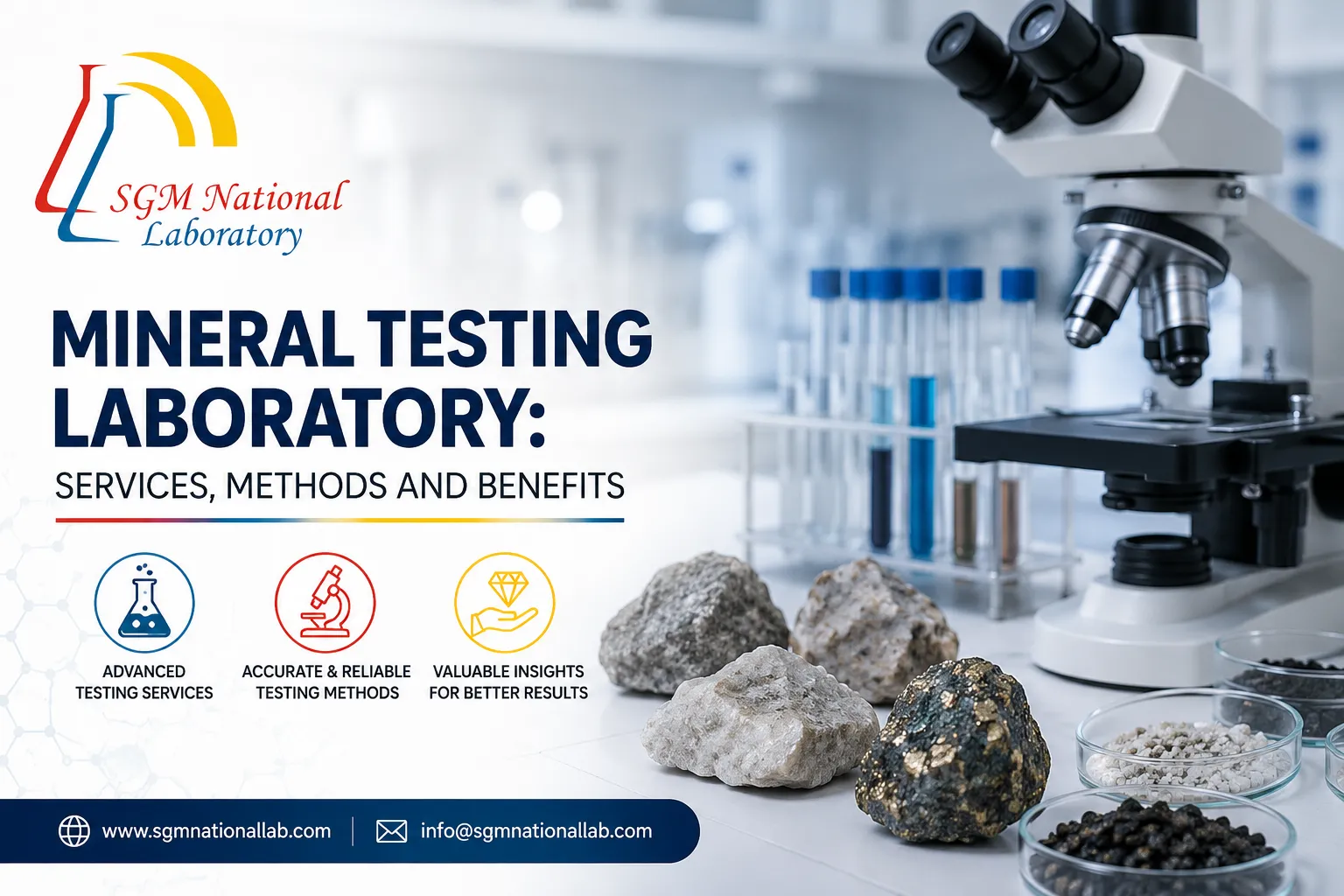
Every mining project, mineral trade and manufacturing process depends on one thing: knowing exactly what the material contains. A mineral testing laboratory provides that answer through accurate, documented analysis. From ore grade and impurity levels to moisture and particle size, reliable test data protects your investment, supports compliance and gives buyers and sellers a common reference point.
This guide explains what a mineral testing laboratory does, the services and methods it uses, the benefits it offers and how to choose the right partner.
What Is a Mineral Testing Laboratory?
A mineral testing laboratory is a specialised facility that analyses the chemical, physical and mineralogical properties of ores, concentrates, rocks, soils and processed minerals. Trained analysts use calibrated instruments and standard procedures to produce reports on composition, purity and quality.
These reports are used throughout the mineral value chain:
- Exploration companies decide whether a deposit is worth developing.
- Mine operators monitor ore grade and plan production.
- Traders and exporters verify quality before shipment.
- Manufacturers confirm that raw materials meet specifications.
- Auditors and regulators check compliance with safety and environmental rules.
Why Mineral Testing Is Important
Minerals are rarely uniform. Two samples from the same mine can differ in grade, moisture and contaminants. Without testing, you are guessing, and guesswork leads to pricing disputes, rejected shipments and wasted processing costs.
Professional testing helps you:
- Establish the true value of a consignment
- Detect harmful impurities early
- Improve extraction and processing efficiency
- Meet buyer, national and international quality standards
- Resolve disputes with independent, documented evidence
Key Mineral Testing Services
Modern mineral testing laboratories offer a wide range of analyses. The scope varies, but most businesses need the following core mineral testing services.
Chemical Analysis
Chemical analysis determines the elemental composition of a sample. It reports the percentage of valuable elements such as iron, aluminium, manganese, copper or zinc, as well as unwanted ones such as silica, phosphorus, sulphur and heavy metals. This data is the foundation of grading and pricing.
Ore Grade and Assay Testing
Assaying measures the concentration of a target metal or mineral in ore. Accurate grade data guides mine planning, processing decisions and commercial negotiations.
Physical Property Testing
Physical tests show how a mineral behaves during handling and processing. Common tests include:
- Moisture content
- Bulk and specific density
- Particle size distribution
- Loss on ignition (LOI)
- Hardness and abrasion characteristics
Mineralogical Analysis
Mineralogical testing identifies which mineral phases are present and how they are arranged. This helps predict how an ore will respond to crushing, grinding, flotation or leaching.
Trace Element and Impurity Analysis
Even small amounts of arsenic, lead, cadmium or mercury can affect safety, marketability and regulatory approval. Trace analysis detects these elements at very low concentrations.
Sampling and Sample Preparation
Results are only as good as the sample. Reliable laboratories follow documented procedures for sampling, crushing, splitting, pulverising and homogenising, so a small portion accurately represents the entire lot.
Third-Party and Pre-Shipment Testing
Buyers and sellers often need a neutral party to verify quality before material moves. Independent testing gives both sides a certified result and reduces the risk of claims and rejections. If you need dependable mineral testing services in India, choose a laboratory that combines technical expertise with standardised procedures to support both domestic trade and export requirements.
Common Methods Used in a Mineral Testing Laboratory
The right method depends on the mineral, the element of interest and the accuracy required. These are the most widely used techniques.
X-Ray Fluorescence (XRF)
XRF is a fast, non-destructive technique that measures the elemental makeup of solid samples. It is popular for quick screening and routine quality control of ores and concentrates.
ICP-OES and ICP-MS
Inductively coupled plasma techniques detect and measure multiple elements at very low levels. They are ideal for trace analysis, precious metals and compliance testing.
Atomic Absorption Spectroscopy (AAS)
AAS measures specific metals in solution. It remains a cost-effective and proven choice for many routine assays.
X-Ray Diffraction (XRD)
XRD identifies the crystalline phases in a sample. It reveals which minerals are present, not just which elements, which is essential for process design.
Fire Assay
Fire assay is the traditional reference method for gold, silver and platinum group metals, valued for its accuracy on precious metal grades.
Wet Chemistry and Titration
Classical chemical methods are still used for major constituents, such as determining iron content. They deliver dependable, high-precision results.
Sieve Analysis and Gravimetric Methods
Sieving determines particle size distribution, while gravimetric methods measure moisture, LOI and other weight-based properties.
A good laboratory often applies more than one method and cross-checks the results, which increases confidence in the final report.
Benefits of Using a Professional Mineral Testing Laboratory
Accurate and Reliable Results
Calibrated instruments, certified reference materials and trained analysts reduce error. Reliable numbers lead to better decisions at every stage.
Fair Pricing and Commercial Confidence
Accurate grading ensures you are paid fairly for what you sell and pay fairly for what you buy. Documented results also make negotiations faster and smoother.
Regulatory and Quality Compliance
Many markets require certified test reports before material can be exported, imported or processed. A mineral testing laboratory that follows recognised standards helps you avoid delays at the port or plant.
Improved Process Efficiency
Knowing the composition of your feed material lets you adjust crushing, blending and recovery processes. This reduces waste, energy use and operating costs.
Reduced Risk
Early detection of harmful impurities or off-spec material prevents costly rejections, penalties and damage to your reputation.
Independent Verification
Third-party results are trusted by all parties, which is especially valuable in cross-border trade where buyer and seller may never meet.
Industries That Rely on Mineral Testing
- Mining and exploration: resource estimation, grade control and feasibility studies
- Steel and metallurgy: quality checks for iron ore, manganese and chromite
- Construction and cement: limestone, gypsum, sand and aggregate testing
- Ceramics and glass: purity of silica, feldspar, clay and quartz
- Chemicals and fertilisers: phosphate, potash and other mineral inputs
- Export and trading: pre-shipment quality certification
How to Choose the Right Mineral Testing Laboratory
Not every lab offers the same level of quality. Consider these factors before you decide:
- Standards and accreditation: Check that the lab follows recognised testing standards.
- Range of services: A lab covering chemical, physical and mineralogical testing saves you from juggling multiple providers.
- Modern equipment: Up-to-date instruments offer better accuracy and lower detection limits.
- Experienced analysts: Skilled professionals interpret results correctly and flag anomalies.
- Turnaround time: Predictable reporting keeps your operations on schedule.
- Clear reports: A good report lists the method, standard, sample details and results.
- Confidentiality and transparent pricing: Your data should be secure, and quotes should have no hidden charges.
Tips for Getting Accurate Test Results
- Collect representative samples from several points in the lot.
- Label every sample clearly and record its source.
- Use clean, sealed containers to avoid contamination.
- Tell the laboratory the intended use so the right tests are selected.
- Keep a retained sample in case re-testing is needed.
Conclusion
A dependable mineral testing laboratory is more than a service provider. It is a partner that gives you the data to price fairly, process efficiently and trade with confidence. From chemical assays and mineralogy to impurity analysis and third-party inspection, the right mineral testing services reduce risk and improve every stage of your operation.
When comparing mineral testing laboratories, focus on accuracy, range of services, standards and clear reporting. To get reliable results for your material, connect with the experts at SGM National Lab today.