Ask most people how they know their drinking water is safe, and you’ll hear the same answers. It looks clear. It doesn’t smell. The RO is running. Fair enough, but none of that tells you much. Arsenic is clear. So are fluoride and nitrate. Even E. coli doesn’t change how a glass of water looks.
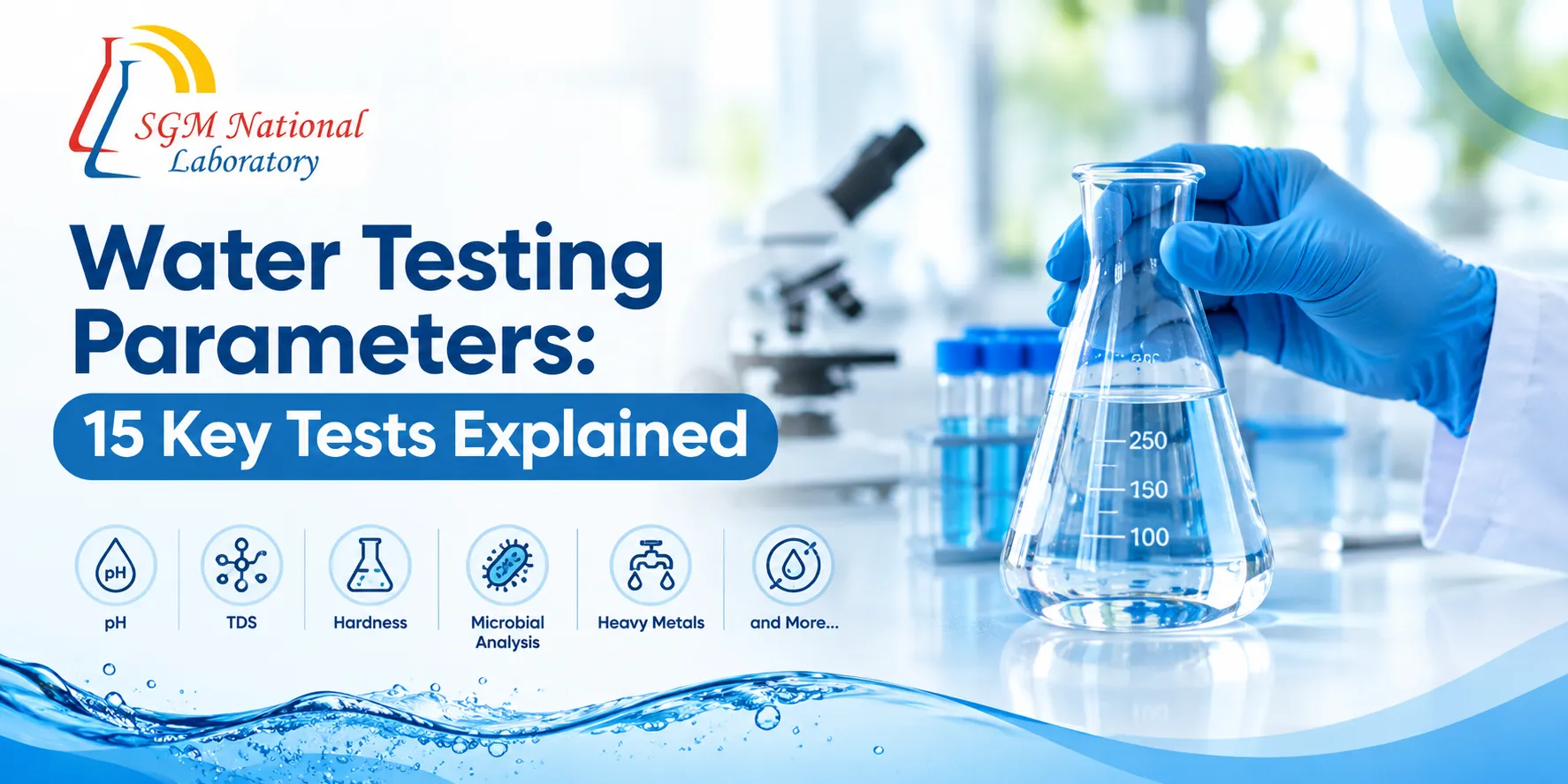
So, the only reliable way to know is to test it. Once you hold a lab report in your hands, you’ll see a list of Water Testing Parameters with technical names and numerical values. This guide explains 15 important water testing parameters in simple words, helping you understand what each test measures and why it matters for water quality.
A quick note on the limits mentioned below: they are based on IS 10500:2012, the Indian drinking water standard. Many parameters have two limits: an acceptable limit, which is the preferred level, and a permissible limit, which may be allowed when no alternative water source is available. Understanding these limits helps you interpret water test results more clearly.
Why water needs testing more than once
Water quality isn’t fixed. It can change with the season, the pipeline, borewell depth, and even nearby construction or industrial activity. A water test report from three years ago may no longer reflect current conditions.
Water testing is not just for homes. Hotels, hospitals, schools, farms, factories, and housing societies all have different reasons to check water quality. Understanding the relevant Water Testing Parameters helps identify which tests are needed for a specific use. That’s why a good water testing lab in India may offer different testing packages, depending on whether you’re checking kitchen tap water, agricultural water, or water used in an industrial boiler.
1. pH
Think of pH as a quick mood check on your water. It runs from 0 to 14, and 7 is neutral. Drinking water should sit between 6.5 and 8.5.
If it’s too acidic, it slowly corrodes your pipes and can carry metals like lead into the water. Too alkaline, and you get a bitter taste and white scale on everything. It’s one of the fastest tests to run, and it often hints at what else might be wrong.
2. Total Dissolved Solids (TDS)
Everyone has seen those little TDS pens. They measure all the minerals and salts dissolved in water. The acceptable limit is 500 mg/L, and up to 2000 mg/L is allowed if nothing better is available.
Here’s what people often miss. A TDS number doesn’t say what’s dissolved. Calcium and magnesium are fine in reasonable amounts. Arsenic isn’t, and it barely moves the TDS needle. So a low reading doesn’t automatically mean safe water.
3. Total Hardness
If your soap doesn’t foam properly and your steel taps grow white crust, you already know hard water. It comes from calcium and magnesium, with 200 mg/L as the acceptable limit and 600 mg/L as permissible.
For a home, it’s mostly irritating. For a factory running boilers, it’s expensive, because scale builds up inside equipment and quietly eats away at efficiency.
4. Turbidity
This simply measures how cloudy the water is. The limit is 1 NTU, stretching up to 5 NTU. A glass that looks a bit milky after heavy rain is a classic example.
Cloudiness itself isn’t the main worry. The tiny particles can shield germs from chlorine, which means disinfection doesn’t do its job properly.
5. Chloride
A little chloride is natural. A lot of it suggests something has crept into the water, maybe sewage, maybe industrial waste, maybe seawater near coastal areas. The acceptable limit is 250 mg/L and the permissible limit is 1000 mg/L.
You’ll often taste it first, a faintly salty edge. It also makes pipes corrode faster, so plant managers keep a close eye on it.
6. Sulphate
Sulphate usually comes from the ground itself, or from certain kinds of industrial waste. Keep it under 200 mg/L, or 400 mg/L at most. Above that, the water tastes bitter and can upset the stomach, especially for children or visitors who aren’t used to it.
7. Alkalinity
Alkalinity is how well your water resists a change in pH. Think of it as a buffer. The acceptable limit is 200 mg/L, up to 600 mg/L.
It won’t hurt you directly, but it affects taste, scaling and how well treatment systems work. If you manage a swimming pool or a treatment plant, you’ll care about this one a lot more than the average household.
8. Fluoride
Fluoride is a funny one, because a small amount actually helps your teeth. Too much does the opposite. The limit is 1.0 mg/L, extendable to 1.5 mg/L.
Over years, high fluoride stains teeth (dental fluorosis) and can stiffen and damage bones and joints (skeletal fluorosis). Groundwater in parts of Rajasthan, Gujarat, Andhra Pradesh and Telangana is known for naturally high levels, so if you rely on a borewell, please don’t skip this test.
9. Nitrate
Nitrate gets into water from fertilisers, septic tanks and animal waste. The limit is 45 mg/L, and the standard doesn’t allow any relaxation.
It’s mainly a risk for babies. Too much can interfere with how a baby’s blood carries oxygen, which is why it’s called blue baby syndrome. If you live near farmland or use a shallow well, test for it, especially if there’s an infant at home.
10. Iron
Those rusty orange stains in the sink and on white clothes? Usually iron. The limit is 0.3 mg/L, with relaxation up to 1.0 mg/L when there’s no alternative.
At normal levels it isn’t a big health threat. But it gives water a metallic taste, clogs pipes and encourages iron bacteria. Plenty of families put in an iron removal filter simply to stop ruining their laundry.
11. Arsenic
This is the one that worries water experts the most. The limit is just 0.01 mg/L, an incredibly tiny amount, and for good reason. Long-term exposure is linked to skin damage, heart and circulation problems and cancer.
You can’t see it. You can’t smell or taste it. Without a test, you’d never know. Parts of West Bengal, Bihar and Uttar Pradesh have well-known arsenic problems, so testing there is a regular habit for many families.
12. Lead and other heavy metals
Lead, cadmium, mercury, chromium and copper can reach your water from industrial waste, old pipes or soldered plumbing. For lead, the limit is 0.01 mg/L.
The trouble with heavy metals is that they build up slowly. Nobody feels sick after one glass, but over time they can harm kidneys and the nervous system, and children are hit hardest. Older buildings and industrial areas deserve extra attention here.
13. Total coliform and E. coli
If I had to pick the single most important test, it might be this one. It checks for bacteria linked to human and animal waste. The standard is zero in a 100 ml sample, with no exceptions.
A positive result can mean diarrhoea, typhoid, cholera or hepatitis A are possible. And here’s something many people don’t realise: water can pass every chemical test and still fail this one. If it does, don’t drink it until it’s been properly treated and retested.
14. Residual chlorine
When water is chlorinated, some chlorine should still be there when it reaches your tap, to keep germs from growing in the pipes. The desirable level is 0.2 mg/L, up to 1.0 mg/L.
Too little and the disinfection hasn’t lasted. Too much and the water smells like a swimming pool and can irritate your eyes and skin. It’s a nice way to check how well your society’s or city’s supply is actually being managed.
15. Dissolved oxygen, BOD and COD
These three are mostly for lakes, rivers, effluent and wastewater, not your kitchen tap. Dissolved oxygen tells you how much oxygen is in the water for aquatic life. BOD and COD show how much organic and chemical pollution it’s carrying.
Industries use them to stay within pollution control board rules. A sudden fall in oxygen, or a spike in BOD and COD, usually means untreated waste is getting in somewhere.
How often should you test?
There’s no perfect schedule, but here’s a sensible rhythm:
- Borewell or well water: once a year, and again after a heavy monsoon or if the taste or smell changes.
- Municipal supply: once a year, or whenever something feels off.
- A new home or society: before you move in, then yearly.
- Hotels, hospitals, food units and factories: whatever your regulations require, often monthly or quarterly.
Also test after floods, pipeline repairs or nearby construction. And if someone in the family keeps getting stomach trouble with no clear reason, check the water before anything else.
Collecting the sample the right way
The best lab in the world can’t fix a badly collected sample. Use the sterile bottle the lab gives you, particularly for bacteria tests. Run the tap for a couple of minutes first. Keep your fingers away from the inside of the bottle and cap. Fill it, write the date and source on it, and get it to the lab fast, since bacterial samples don’t stay reliable for long.
Picking a lab you can trust
A test is only as good as the people behind it. Look for trained chemists, calibrated equipment and a report you can actually read. A good water analysis lab in India should explain your results in simple words, not just hand over a page of numbers.
Before you book, ask which parameters are covered, how long results take, and whether the report shows the permissible limits next to your values. Those three questions save a lot of confusion later.
Final thoughts
You don’t need a science degree to understand Water Testing Parameters. Once you know what each test measures, a lab report becomes less intimidating and more useful. It helps you understand water quality and decide what steps to take next.
Start with the basic tests, pay extra attention to contaminants that may be common in your area, and arrange regular testing based on your water source and intended use. Clean water is easy to take for granted until a test report reveals a problem. Regular water testing helps you make informed decisions and protect water quality.
If you’d like your water checked by professionals, get in touch with SGM National Lab.
FAQ
Common physical and chemical parameters include pH, turbidity, TDS, hardness, alkalinity, chloride, sulphate, fluoride, nitrate and iron, plus microbiological tests where needed.
Total dissolved solids shows the amount of dissolved minerals and salts. High TDS can affect taste, cause scaling and limit suitability for drinking or industrial use.
IS 10500 lists an acceptable pH range of 6.5 to 8.5 for drinking water.
High fluoride can cause dental and skeletal fluorosis, and high nitrate is a health risk, especially for infants. Both are checked in drinking water.
Boilers and cooling systems need hardness, alkalinity, chloride, silica, TDS and iron checks to prevent scaling and corrosion.
Use a clean bottle rinsed with the same water, fill it completely, label it and send it quickly. Microbiological tests need a sterile container.
Results are commonly compared with IS 10500 and WHO guidelines for drinking water, and with CPCB norms for effluents.