
Look at any bag of NPK fertilizer at a dealer’s counter. Right there on the front: 10:26:26, or 12:32:16, or 19:19:19. Farmers read it. Dealers price it. Inspectors check against it. But who checks the bag?
That’s the job of a fertilizer testing lab. It’s not glamorous work. Mostly it’s weighing, digesting, filtering and reading instruments. But the number that comes out at the end can decide whether a batch gets shipped, whether a buyer pays in full, or whether a licence stays valid.
If you’ve ever sent a sample off and got back a report full of terms like “citrate-soluble P2O5” with no idea what to make of it, this one’s for you. Below, we walk through what an NPK fertilizer lab actually looks at, why, and where people usually go wrong.
What Does an NPK Fertilizer Testing Lab Actually Do?
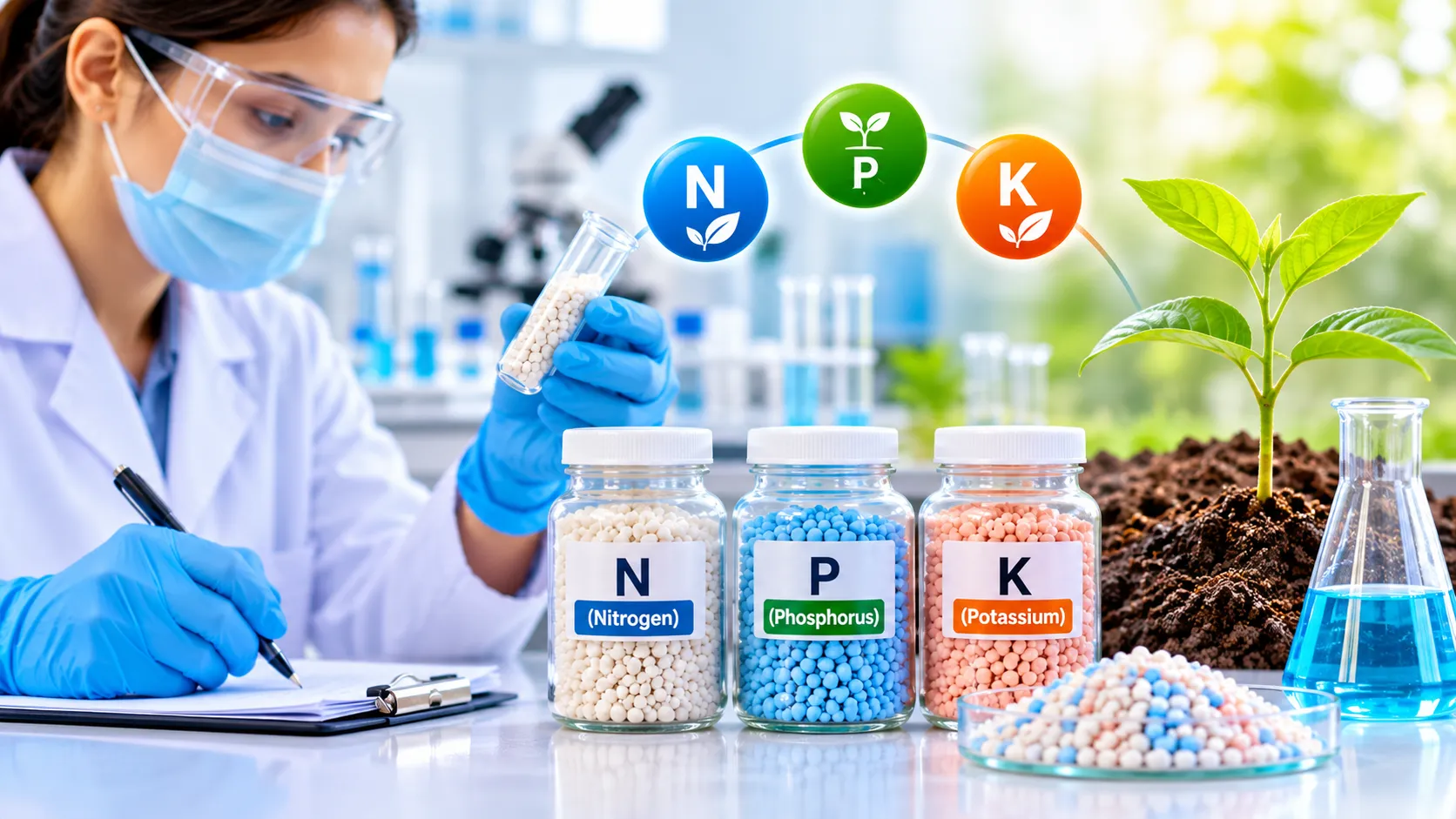
Short answer: a fertilizer testing lab takes a small bit of your product and tells you what’s in it.
Longer answer: it checks three different things. First, the nutrients, which is the chemistry part. Second, how the product behaves physically, in the bag, on the truck, in the spreader. And third, whether anything harmful has
Those Three Numbers, Decoded
The order never changes. N first, P second, K third. A 12:32:16 product should have 12% nitrogen as N, 32% phosphorus written as P2O5, and 16% potassium written as K2O. If the oxide part feels odd, you’re not alone. It’s a convention that goes back a long way. Nobody actually spreads P2O5 on a field. But Indian rules and the whole trade still talk in these terms, so every fertilizer testing lab reports results the same way. What you really want from the report is the gap. Declared 32, found 30.9? That gap is the story.
Who Actually Sends Samples?
Manufacturers, mostly. They test finished batches and, if they’re careful, their raw material as well, things like rock phosphate and muriate of potash.
But it’s not only them. Importers and traders want proof before they pay. A dealer might send in a few bags that just don’t look right. Agriculture departments and research teams send trial blends. Everyone wants roughly the same numbers. They just want them for very different reasons.
Nitrogen, Phosphorus and Potassium: The Core Checks
Each of the three nutrients has its own method. Any fertilizer testing lab worth trusting treats them as three separate jobs, not one.
Nitrogen Isn't Just One Thing
Nitrogen can sit in a fertilizer as ammoniacal N, nitrate N or urea N. To a crop, these aren’t the same. Nitrate gets taken up quickly. Urea has to break down in the soil before the plant can use it.
For total nitrogen, the classic method is Kjeldahl. It’s old (we’re talking 1880s old) but it works, and it’s still the standard in a lot of places. If a product claims a particular nitrogen form on its label, the NPK fertilizer lab has to split that out separately. Nitrate, for instance, is usually picked up after reduction with Devarda’s alloy.
Phosphorus Is Where the Fights Happen
Ask anybody who’s been in the fertilizer business for a few years. When a fertilizer testing lab report starts a quality dispute, it’s very often about phosphorus.
The reason is simple. Total P2O5 can look perfectly fine on paper while a good share of it sits there, not dissolving, doing very little for the crop. That’s why a proper fertilizer testing lab reports water-soluble and citrate-soluble phosphorus separately instead of giving you one total. Buyers tend to care most about the water-soluble figure. It tells them how fast the nutrient will be available once it’s in the field.
Potassium: Easy Chemistry, Tricky Sampling
Potassium is reported as water-soluble K2O. Flame photometry is common, and there are gravimetric methods too. Honestly, the testing part is the easy bit.
The harder part is the sample. In a bulk blend, potash granules sit loosely beside the others. Scoop badly and you might grab more potash than average, or less. The lab will measure exactly what you sent. Whether that matches your whole lot is a different question.
Beyond NPK: Physical and Secondary Parameters
A product can hit its grade to the decimal and still give you trouble. So an NPK fertilizer lab looks further than the three headline nutrients.
Moisture
Anyone who has stored fertilizer through a humid monsoon knows this one. Damp granules soften and stick. Before long, a 50 kg bag has turned into one solid lump that nobody can spread. Moisture also dilutes the nutrients, so your percentages slide.
It’s one of the cheapest tests you can ask a fertilizer testing lab for. And it’s often the first thing worth checking when a customer complains.
Particle Size and Granule Strength
Granular products are supposed to stay inside a set size range. Too many fines means dust, waste and patchy spreading. Oversized granules don’t spread well either. A sieve analysis shows how much of the product falls in the right band. Some buyers also ask for crushing strength. Weak granules break apart during loading, on bumpy roads and at the bottom of tall stacks.
Micronutrients and Contaminants
Fortified NPK grades often carry sulphur, zinc or boron on the label. Those get tested against their claims, same as the main three. Then there’s the stuff that shouldn’t be there. If a specification asks for it, a fertilizer testing lab will check heavy metals like lead, cadmium, arsenic and mercury. With urea-based products, biuret is worth watching, because too much of it can harm sensitive crops. When these results come back clean, nobody gives them a second thought. Which is exactly how it should be.
Why NPK Testing Matters for Manufacturers, Traders and Farmers
A lot of people see testing as a cost. We’d argue the opposite. Most of the time, a report from a fertilizer testing laboratory saves far more than it costs.
The Fertiliser Control Order
In India, fertilizer quality is governed by the Fertiliser (Control) Order, 1985, which sits under the Essential Commodities Act. It sets out specifications for notified products, including nutrient content.
Inspectors draw samples from factories, warehouses and shops. A failed sample can get a product declared non-standard. After that, you could be looking at seized stock or, in serious cases, a cancelled licence. Testing regularly with an independent fertilizer testing laboratory means you hear about a problem from your own report first, not from an inspector.
Going Over the Grade Costs You Too
Everyone worries about falling short. Very few people think about overshooting.
But think about it. If your plant puts in a little more phosphate than needed on every batch, that extra material is free. You’re paying for it, and nobody is paying you back. Over a season, that adds up to real money. Falling short is worse, sure, because then come the complaints and the penalties. Regular results from a fertilizer testing lab help your production team stay close to the declared grade on both sides.
Trust, All the Way Down the Chain
A trader who can show a fresh report from an independent fertilizer testing lab has an easier time with buyers. An importer with a pre-shipment check knows what’s coming before the payment goes out.
And at the very end, there’s a farmer. They don’t see the report. They just see whether the crop responds. That’s really what all of this is for.
How a Sample Moves Through the Lab
A lot of “bad results” aren’t bad results at all. They’re bad samples. Knowing how an NPK fertilizer lab handles yours helps you avoid that.
Getting the Sample Right
One scoop off the top of one bag tells you about that scoop. Not much else.
Take small portions from several bags, or from different spots in a heap. Mix them properly. Then reduce the pile by quartering until you’ve got a sensible amount to send. Use a clean, airtight container. Label it clearly with the grade, batch number and date. It sounds obvious. It gets skipped all the time.
On the Bench
When the sample arrives at the fertilizer testing lab, it gets logged, ground if needed, and divided up for each test. Moisture is usually done first, since the sample can gain or lose water just sitting in the air. The chemical tests follow, run on calibrated instruments using standard methods. Reference materials and repeat readings are there to make sure the numbers can be trusted.
Reading Your Report
A good report shows the parameter, the method, the result and the unit. Tell the fertilizer testing laboratory your declared grade, and they can put the two side by side for you.
When you read it, look at how phosphorus is reported. Check whether moisture was measured on the sample “as received.” And if anything looks odd, call. A five-minute chat with the analyst often clears up what the report alone can’t.
How to Choose the Right Fertilizer Testing Lab
Not every lab offers the same thing. Before you send a sample, it’s worth asking a few questions to see whether a fertilizer testing lab suits what you need.
Questions Worth Asking
- What methods do you use for nitrogen forms and soluble phosphorus?
- Can micronutrients and heavy metals go in the same test package?
- How much sample do you need, and how should it be packed?
- How long will the report take?
- Can your team help me pick the right parameters?
If a fertilizer testing lab gives you clear answers before you’ve sent anything, chances are the report will be clear too. Looking for one in Rajasthan or elsewhere in India? SGM National Laboratory offers a fertilizer testing laboratory service for NPK, organic, micronutrient and specialty fertilizers, with test parameters chosen for each formulation.
Mistakes We See People Make
Most problems start before the sample ever gets to the fertilizer testing lab.
The sample goes in a loose polythene bag and soaks up moisture on the way. One bag gets tested and treated like it represents a full truckload. The declared grade isn’t mentioned, so nobody can flag a shortfall. Or the request says “total phosphorus” when the buyer actually wanted water-soluble. Every one of these can be avoided with a quick call to the NPK fertilizer lab before you collect the sample.
Conclusion
Three small numbers on a fertilizer bag carry a surprising amount of weight. They shape what goes on the field, what a buyer pays and what an inspector expects to find. A reliable fertilizer testing lab is how you make sure those numbers are true. And it checks more than N, P and K: moisture, granule quality, micronutrients and contaminants all come into it.
If you manufacture, testing protects your margins and keeps you within the Fertiliser Control Order. If you trade, it settles arguments before they start. And for the farmer, it means the nutrients they paid for actually reach the crop. Make testing a routine habit rather than a last-minute scramble, and pick a fertilizer testing lab that explains how it tests as clearly as it reports what it finds.
Frequently Asked Questions (FAQs) About NPK Fertilizer Testing
N, P and K stand for nitrogen, phosphorus (as P2O5) and potassium (as K2O), the three primary plant nutrients.
Labs use standard chemical methods to measure each nutrient form and report it as a percentage of the product.
Moisture, particle size, pH, water-soluble content, micronutrients and, where required, heavy metals.
Poor mixing, variation in raw materials, moisture pick-up or mislabelling can cause differences, which is why batch testing is useful.
Manufacturers, blenders, dealers, importers and farmer groups who want proof of nutrient content.
Keep them in airtight, labelled bags to avoid moisture absorption, which can change the results.
Yes. SGM tests NPK, urea, DAP, organic and micronutrient fertilizers for the parameters you specify.