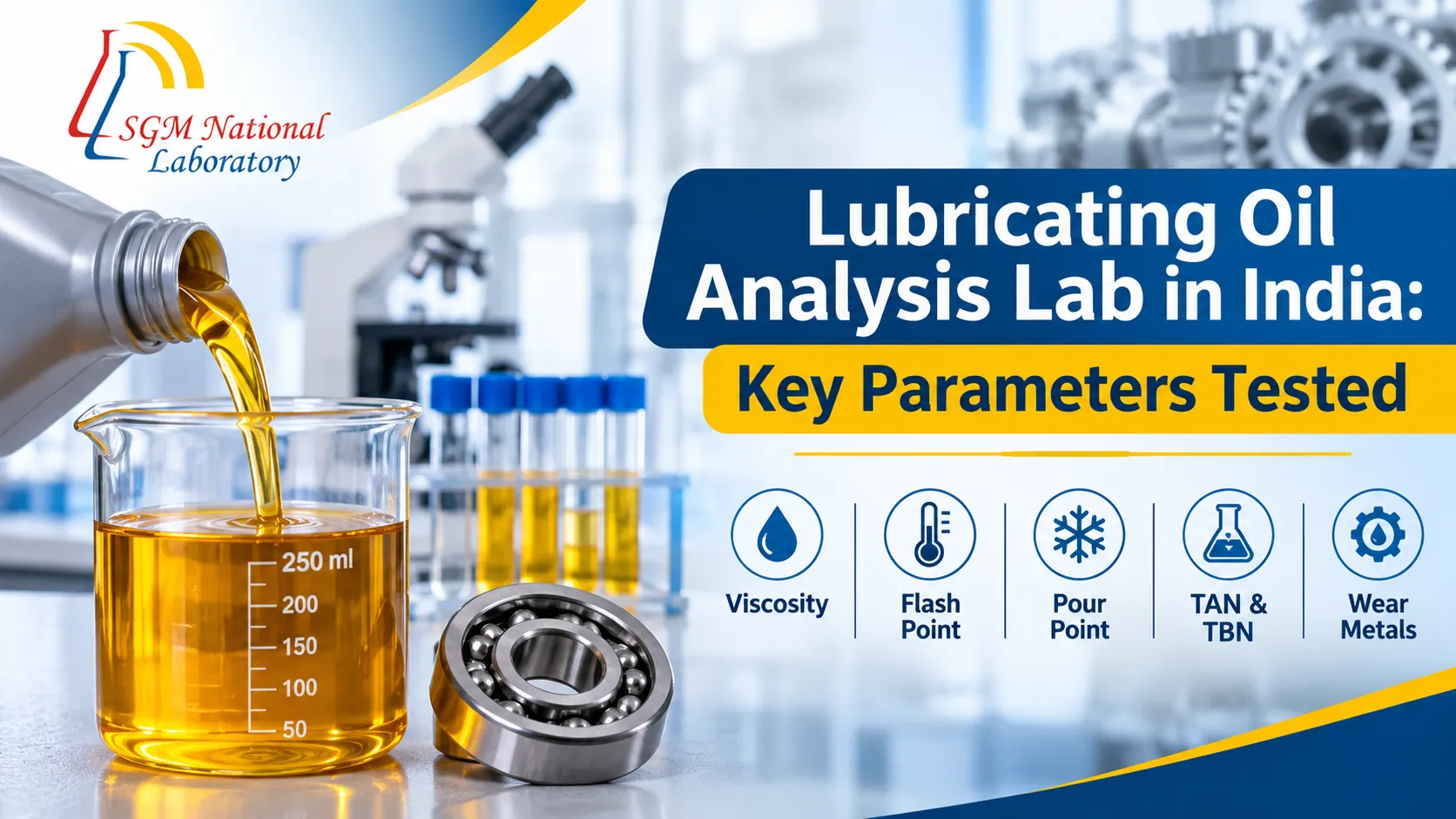
Every turbine, gearbox, compressor, hydraulic press and diesel engine in an Indian plant depends on one thing to keep running smoothly: clean, healthy lubricating oil. When that oil breaks down, gets contaminated or starts carrying metal particles, the damage to machinery begins long before anyone hears a strange noise or sees a temperature spike. That is exactly why industries across the country are turning to a professional lubricating oil analysis lab to check the condition of their lubricants at regular intervals.
A reliable lab does far more than tell you whether oil is “good” or “bad.” It measures specific physical and chemical parameters that reveal how the lubricant is performing, how the machine is wearing and what is likely to fail next. In this guide, we explain what a lubricating oil testing lab does, the key parameters it tests, and how the results help you plan maintenance, extend oil drain intervals and avoid costly breakdowns.
What Is a Lubricating Oil Analysis Lab?
A lubricating oil analysis lab is a specialised testing facility that examines new and in-service lubricants using standardised methods such as ASTM, IS (BIS) and ISO procedures. Samples taken from engines, gearboxes, hydraulic systems, turbines and transformers are tested to answer three core questions:
- Is the oil still fit for use? (lubricant condition)
- Has anything entered the oil that should not be there? (contamination)
- Is the machine wearing abnormally? (wear debris)
Modern lubricant testing laboratory setups use instruments like kinematic viscometers, Karl Fischer titrators, FTIR spectrometers, ICP-OES elemental analysers and automatic particle counters. Together, these tools turn a small bottle of oil into a detailed health report for your equipment. If you are looking for a trusted partner, a dedicated lubricating oil analysis lab in India such as SGM National Lab can provide accurate, standards-based reports for both new and used oil.
Why Lubricating Oil Analysis Matters for Indian Industries
India’s industrial base runs in demanding conditions — high ambient temperatures, dust, humidity during the monsoon and long operating hours. These factors accelerate oil oxidation, moisture ingress and contamination. Regular lubricating oil analysis helps you:
- Prevent unplanned breakdowns by detecting wear and contamination at an early stage.
- Optimise oil change intervals instead of replacing oil on a fixed calendar, which saves money and reduces waste oil.
- Extend equipment life by keeping lubricants within healthy limits.
- Verify supplier quality through oil quality testing of fresh lubricant deliveries.
- Support compliance and audits with documented, traceable test results.
For plants that run critical assets, the cost of one avoided failure often exceeds the cost of an entire year of testing.
Key Parameters Tested in a Lubricating Oil Testing Lab
The exact test package depends on the type of oil and equipment, but the following parameters form the backbone of most industrial oil analysis programmes.
Kinematic Viscosity (ASTM D445)
Viscosity is the single most important property of any lubricant. It measures the oil’s resistance to flow, usually at 40°C and 100°C. If viscosity rises, it can indicate oxidation, soot loading or mixing with a heavier oil. If it falls, the cause may be fuel dilution, shearing of viscosity improvers or contamination with a lighter product. A change of more than about 10% from the new oil value is typically a warning sign.
Viscosity Index (ASTM D2270)
The viscosity index (VI) shows how much the oil’s viscosity changes with temperature. A higher VI means more stable performance across hot and cold conditions — important for equipment that starts cold and runs hot, a common scenario in Indian plants.
Total Acid Number – TAN (ASTM D664 / D974)
TAN measures the acidic compounds in the oil, which build up as the lubricant oxidises. A rising TAN signals that the oil is ageing and may start corroding metal surfaces. TAN trending is especially important for turbine oils, hydraulic oils, gear oils and compressor oils.
Total Base Number – TBN (ASTM D2896 / D4739)
TBN is mainly tested in engine oils. It shows the remaining alkaline reserve available to neutralise acids formed during combustion. When TBN drops too low, the engine loses its protection against corrosive wear, which tells you it is time for an oil change.
Water Content (Karl Fischer, ASTM D6304)
Water is one of the most damaging contaminants in lubricating oil. Even a few hundred ppm can reduce film strength, promote rust, deplete additives and accelerate oxidation. Karl Fischer titration gives precise water content in ppm, while a quick crackle test can be used for screening. Moisture monitoring is critical during India’s monsoon season and in humid coastal plants.
Flash Point (ASTM D92 / D93)
Flash point is the lowest temperature at which oil vapours ignite. A sudden drop in flash point usually indicates fuel dilution in engines or contamination with a lower-flash solvent. It is also an important safety parameter for storage and handling.
Wear Metals and Elemental Analysis (ASTM D5185)
Using ICP-OES spectroscopy, the lab measures elements such as iron, copper, lead, tin, aluminium, chromium and nickel. Each metal points to a specific component — for example, iron from gears and cylinder liners, copper and lead from bearings, and aluminium from pistons. The same test also detects contaminant elements like silicon (dirt) and sodium or potassium (coolant leaks), as well as additive elements like zinc, phosphorus, calcium and magnesium.
Particle Count and Cleanliness Code (ISO 4406)
For hydraulic systems, turbines and precision machinery, cleanliness is everything. An automatic particle counter measures particles at 4, 6 and 14 microns and reports an ISO 4406 cleanliness code, such as 18/16/13. Rising particle counts indicate filter failure, ingress of dirt or internal wear.
Oxidation, Nitration and Soot (FTIR, ASTM E2412)
Fourier Transform Infrared (FTIR) spectroscopy creates a chemical fingerprint of the oil. It detects oxidation, nitration, sulphation, soot, glycol and additive depletion in a single test. Comparing used oil spectra with the new oil reference makes it easy to see how far the lubricant has degraded.
Other Supporting Tests
Depending on the application, a lubricant testing laboratory may also perform:
- Pour point (ASTM D97) – lowest temperature at which oil still flows.
- Foaming characteristics (ASTM D892) – tendency to form stable foam.
- Demulsibility (ASTM D1401) – ability to separate from water, vital for turbine and hydraulic oils.
- Copper strip corrosion (ASTM D130) – corrosiveness towards yellow metals.
- RPVOT (ASTM D2272) – remaining oxidation life of turbine oils.
- Analytical ferrography – visual examination of wear particles to identify the type of wear mechanism.
Used Oil Analysis vs New Oil Quality Testing
An oil testing lab in India typically handles two broad kinds of work:
New oil quality testing checks that a fresh lubricant meets its specification before it goes into your machines. It confirms viscosity grade, flash point, additive levels and cleanliness, and protects you from adulterated or off-spec supplies.
Used oil analysis examines oil that has been in service. Here, the focus is on trends — how viscosity, TAN, water, wear metals and particle counts change from one sample to the next. A single result tells you the current state; a series of results tells you where the machine is heading.
The best programmes combine both: a baseline test on new oil, followed by periodic used oil analysis compared against that baseline.
How Oil Condition Monitoring Reduces Downtime
Oil condition monitoring is a core part of predictive maintenance. Instead of waiting for a failure or changing oil blindly, you take samples at fixed intervals — for example, every 250 to 500 operating hours for engines or monthly for critical hydraulic and turbine systems — and let the data guide decisions.
A typical monitoring workflow looks like this:
- Sampling – Collect a representative sample from the same point, under the same operating conditions, using clean bottles.
- Testing – The lab runs the agreed test package.
- Reporting – Results are compared with alarm limits and previous trends, and flagged as normal, caution or critical.
- Action – Maintenance teams act on recommendations, such as changing filters, fixing seals, draining water or scheduling a bearing inspection.
When this cycle runs consistently, plants usually see fewer emergency repairs, longer oil life and better planning of shutdowns.
Industries That Rely on Industrial Oil Analysis
Industrial oil analysis is valuable wherever rotating or reciprocating equipment is critical to output. Common users include:
- Power plants – steam and gas turbine oils, transformer oils, hydraulic control fluids.
- Steel, cement and mining – heavy-duty gear oils, hydraulic oils and greases under high load and dust.
- Automotive and transport fleets – engine oil analysis for trucks, buses, locomotives and gensets.
- Manufacturing and engineering – CNC machine hydraulics, compressors and spindles.
- Oil and gas, petrochemicals and refineries – compressor and pump lubricants.
- Marine and ports – engine and stern tube oils exposed to saltwater.
- Textiles, paper and food processing – gearboxes, hydraulics and food-grade lubricants.
How to Choose the Right Lubricating Oil Analysis Lab in India
Not every oil testing lab delivers the same level of accuracy and insight. When selecting a partner, look for:
- Accreditation – A NABL-accredited lab working to ISO/IEC 17025 offers confidence in the reliability of results.
- Standard test methods – Testing should follow recognised ASTM, IS and ISO methods.
- Comprehensive test range – From basic viscosity and water checks to ICP, FTIR and particle counting under one roof.
- Fast turnaround – Quick reports matter when a critical asset is at risk.
- Clear interpretation – Reports should include trend data, alarm limits and practical recommendations, not just numbers.
- Experienced analysts – Chemists and tribology specialists who understand both lubricants and machinery.
- Sampling support – Guidance on sampling points, intervals and proper bottles.
SGM National Lab offers a wide range of lubricant and oil testing services for industries across India, helping maintenance teams make confident, data-driven decisions.
Conclusion
Lubricating oil carries a continuous record of your machine’s health. Viscosity, TAN, TBN, water content, flash point, wear metals, particle count and FTIR results each reveal a different part of that story — from oil ageing and contamination to the early signs of bearing, gear or engine wear. By working with a professional lubricating oil analysis lab, you can move from reactive repairs to planned, predictive maintenance, extend both oil and equipment life, and protect your production from unexpected downtime.
Whether you need new oil quality testing, routine used oil analysis or a complete oil condition monitoring programme, partnering with an experienced, standards-driven laboratory is a smart investment. To learn more about the testing services available, visit our lubricating oil analysis lab in India page or contact SGM National Lab to set up a testing plan tailored to your equipment.
Frequently Asked Questions About Lubricating Oil Analysis
A lubricating oil analysis lab tests viscosity, TAN, TBN, water content, flash point, wear metals, particle count and oxidation. Together, these results reveal the oil's condition, any contamination present and how fast machine parts are wearing.
Most plants test critical equipment every month or every 250 to 500 operating hours, while less critical machines can be tested quarterly. The right interval depends on equipment criticality, operating conditions and the OEM's recommendations.
New oil testing checks that fresh lubricant meets its specification before use. Used oil analysis examines oil already in service to track degradation, contamination and wear trends, helping you decide when to change oil or service a machine.
Water weakens the oil film, causes rust and corrosion, depletes additives and speeds up oxidation. Even a few hundred ppm can damage bearings and gears, which is why labs use Karl Fischer titration to measure moisture in lubricating oil accurately.
Take the sample from the same point each time, while the machine is running or just after shutdown when the oil is warm and well mixed. Use a clean, dry bottle, avoid drain plugs, and label it with equipment details, oil hours and sampling date.
Yes. Instead of changing oil on a fixed schedule, oil condition monitoring shows whether the lubricant is still healthy. If viscosity, TAN and additive levels stay within limits, you can safely extend drain intervals and cut oil costs and waste.
Routine tests like viscosity, water content and TAN usually take one to three working days after the sample reaches the lab. Advanced tests like RPVOT or ferrography can take longer, so confirm turnaround for your test package with SGM National Lab.