
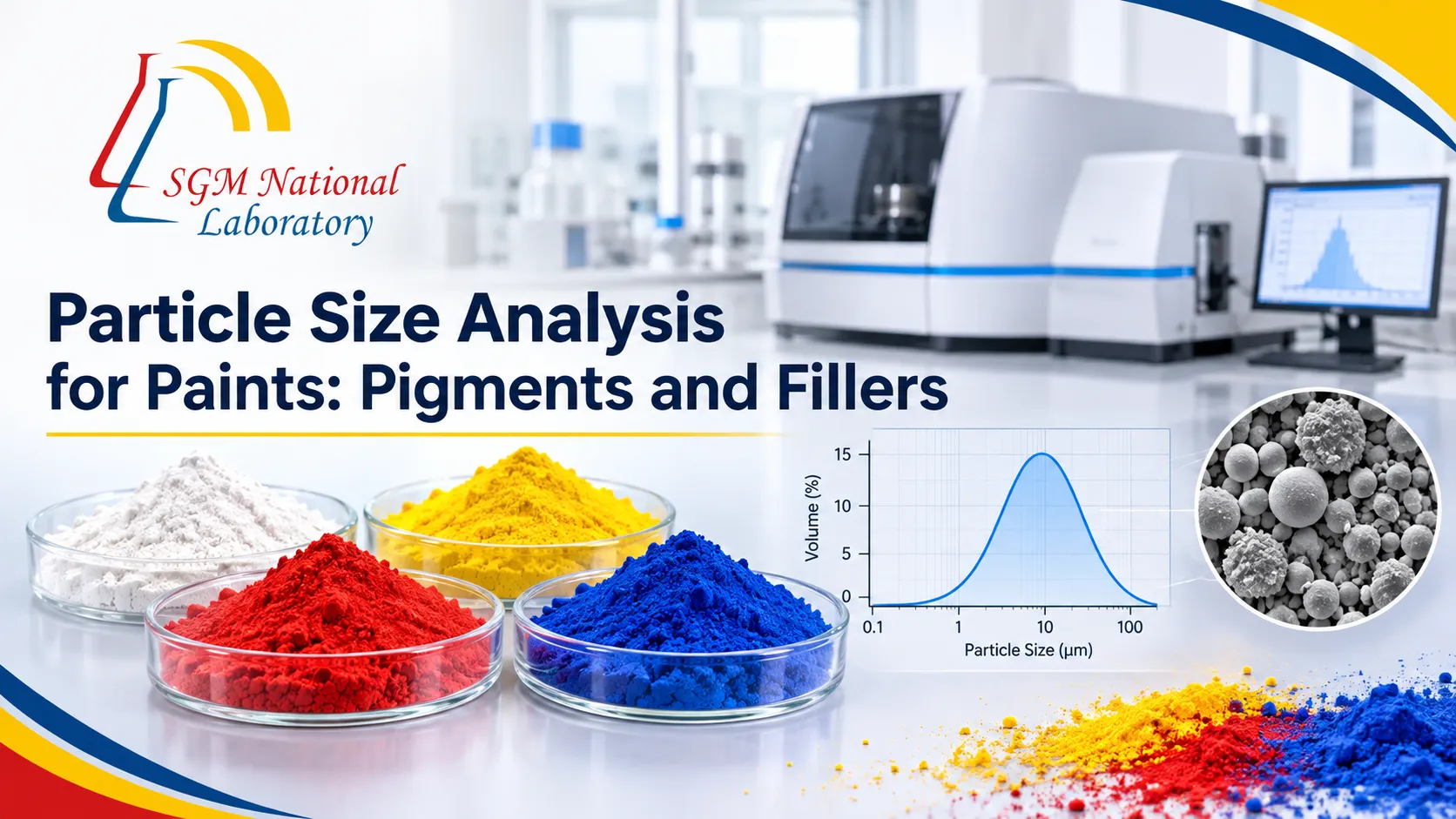
Here’s a situation we hear about more often than you’d think. A paint plant switches to a new calcium carbonate supplier because the price is better. The test report looks fine, the colour looks fine, and production goes ahead. Three weeks later, the complaints start. The emulsion has thickened in the drum, the sheen is off, and a dealer in another state is sending back stock.
Nothing was wrong with the recipe. The filler was simply coarser than the old one, and nobody had checked.
This is exactly where Particle Size Analysis earns its place. It’s not a fancy extra for big R&D labs. For anyone making paints, primers, putties or coatings, it’s one of the simplest ways to stop a small raw material change from turning into a costly batch problem. Let’s walk through why it matters, what it actually tells you, and how to get it done properly.
Why Particle Size Matters So Much in Paint
Think of paint as millions of tiny solid particles floating in a liquid binder. When the paint dries, those particles lock into place and form the film you see on the wall. Their size decides how that film looks, how it feels and how long it lasts.
The tricky part is that you can’t see the problem by eye. Two bags of titanium dioxide or talc can look identical and still behave very differently in your mixer. Particle Size Analysis turns that invisible difference into numbers you can compare, batch after batch.
Pigments and Fillers Don't Play the Same Role
It helps to separate the two, because their size targets are not the same. Pigments, like titanium dioxide, iron oxides and organic colourants, are there for colour and coverage. Their size has to sit in a fairly narrow window because it controls how they handle light. Fillers, also called extenders, include calcium carbonate, talc, china clay, barytes, mica and silica. They bring body, cut cost, adjust sheen and add strength to the film. Their size range is wider, but it still matters a lot. A filler that’s too fine soaks up binder. One that’s too coarse ruins the finish.
How Particle Size Changes the Way Paint Behaves
Hiding Power and Opacity
Titanium dioxide is the classic case. It scatters light best when its particles are around 0.2 to 0.3 microns, roughly half the wavelength of visible light. Drift too far either way and you lose hiding power, which means you need more TiO2 to get the same coverage.
Since TiO2 is usually the most expensive thing in a white or pastel paint, that drift hits your margins directly. It’s the reason a lot of manufacturers now ask their particle size analysis services partner to check every fresh lot before it reaches the shop floor.
Gloss and Finish
A good gloss enamel needs a smooth surface. If a few coarse particles stick out of the dried film, light scatters instead of reflecting cleanly, and the paint looks flat. Sometimes it even feels gritty to the touch.
Matt and eggshell paints work the other way. They actually rely on controlled coarse fillers to break up the light. So the goal isn’t always “finer is better”. The goal is the right size for the finish you’re selling.
Colour Strength and Shade Matching
Well-dispersed, fine colour pigments give brighter, stronger tints. When particles clump together, colour strength drops and shades start wandering from batch to batch. Anyone who has tried to match a shade card across three production runs knows how frustrating that is.
Regular testing through particle size analysis services helps quality teams catch poor dispersion early, before an entire tank of off-shade paint is made.
Viscosity, Shelf Life and Settling
Finer particles have more surface area, so they drink up more binder and push viscosity up. Coarser, heavier particles sink faster during storage. Get the balance wrong and you either end up with paint that’s hard to brush, or a hard cake at the bottom of the tin that no painter on site is going to stir back in.
Durability of the Dried Film
When fillers of different sizes are well graded, the small ones fill the gaps between the large ones. The result is a tighter, denser film that stands up better to rain, scrubbing and sunlight. This ties in with critical pigment volume concentration (CPVC), the point where there isn’t enough binder left to coat every particle. Knowing your size distribution lets you formulate close to that limit without crossing it.
Common Methods Used for Particle Size Analysis
There’s no single test that suits every powder. A good particle size analysis lab picks the method based on your material, its size range and what you actually need to know.
Laser Diffraction
This is the go-to method for most pigments and fillers. A laser passes through a dispersed sample, and the pattern of scattered light is converted into a full size distribution, from below a micron up to a few millimetres. It’s quick, repeatable and follows ISO 13320. You’ll usually see results as D10, D50 and D90, which simply tell you the size below which 10%, 50% and 90% of the particles fall.
Dynamic Light Scattering (DLS)
For very fine and nano-scale materials, such as certain organic pigments, nano-silica or colloidal additives, DLS works better. It tracks how particles move in a liquid and calculates their size from that motion. It’s handy for checking dispersions and emulsions, though not every particle size analysis lab has the equipment, so it’s worth asking first.
Sieve Analysis
Old-fashioned, but still useful for coarse fillers and texture coatings. Most particle size analysis services offer it as a low-cost way to catch oversize material that could leave bits in the film.
Hegman Gauge (Fineness of Grind)
Almost every paint plant has one of these on the shop floor. It’s a quick check on how well a batch has been dispersed. The catch is that it only shows the biggest particles or clumps. It won’t give you a full distribution, so treat it as a production check that works alongside lab-based Particle Size Analysis, not a replacement for it.
Making Sense of a Particle Size Report
The first time you get one of these reports, the curves and numbers can feel a bit much. In practice, you only need to focus on a handful of values.
The D50 is the median size and the number most specifications are written around. The D90 (and sometimes D97) shows the coarse end, and for gloss paints this is often the number that matters most, because it reveals the oversize particles. The D10 shows the fine end, which helps you judge binder demand and viscosity. The span tells you how wide the spread is. A narrow span usually means more predictable behaviour in the can.
One tip we always share: don’t compare two materials on D50 alone. Two powders can have the same median and still perform very differently. Look at the full curve, and if something doesn’t make sense, your particle size analysis lab should be happy to explain it.
When Should You Use Particle Size Analysis Services?
You don’t need to test everything, every day. But there are a few moments where it really pays off.
Approving Raw Materials and New Suppliers
Before a new pigment or filler goes into production, compare it against your approved grade. This matters most when you switch suppliers to save cost, because a cheaper grade is often coarser or wider. A quick check through particle size analysis services costs far less than one rejected batch.
Developing New Products
Starting a new emulsion or primer with clear size targets saves weeks of trial and error. Many formulators share their target D-values with their particle size analysis lab at this stage, so every later batch is tested against the same reference.
Fixing Complaints and Process Issues
When gloss drops or settling suddenly gets worse, size data helps you figure out whether the cause is the raw material or your milling process. It also tells you whether you’re over-grinding, which wastes power and time.
Export and Customer Documents
If your customers ask for technical data sheets or certificates of analysis, results from an independent particle size analysis lab carry more weight than in-house numbers.
Many small and mid-sized paint units in India don’t own a laser diffraction instrument, and honestly, they don’t need to. Outsourcing to reliable particle size analysis services gives them the same quality of data large companies use, without the cost of buying and maintaining the equipment.
What to Look for in a Particle Size Analysis Lab
Not every particle size analysis lab will give you results you can act on. Before you send samples, ask a few simple questions.
Does the lab offer more than one method, so the test suits your material? Do they prepare samples properly, with the right dispersant and sonication? Poor preparation is the most common reason a particle size analysis lab produces misleading results. Do they follow recognised standards like ISO 13320? Will you get the full distribution and a readable graph, not just one number? And can their particle size analysis services team turn results around quickly? In production, waiting two weeks usually isn’t an option.
At SGM National Lab, we test pigments, fillers and other industrial powders for manufacturers across the country. If you’re looking for dependable Particle Size Analysis in India, our team can help you choose the right method, sample quantity and report format for your product.
Conclusion
A lot of paint problems are really particle problems in disguise. Hiding power, gloss, colour strength, viscosity, shelf life and durability all come back to how big your pigment and filler particles are and how evenly they’re spread. Particle Size Analysis replaces guesswork with real data, so you can approve raw materials with confidence, tune your milling and solve complaints faster.
Whether you’re launching a new product, trying out a cheaper filler or simply want every batch to match the last one, working with a trusted particle size analysis lab is a practical step forward. Get in touch with SGM National Lab to discuss your requirements and see how our particle size analysis services can support your paint and coatings business.
Frequently Asked Questions
Particle size analysis measures the size and spread of pigment and filler particles in paint. It shows the full distribution, not just an average, so you can predict how the paint will behave in terms of gloss, coverage, viscosity and settling.
Titanium dioxide scatters light best at around 0.2 to 0.3 microns. If the size drifts finer or coarser, hiding power drops and you need more TiO2 for the same coverage, which quietly raises the cost of every litre of white or pastel paint.
Fillers like calcium carbonate, talc and china clay control body, sheen and strength. Very fine fillers soak up binder and thicken the paint, while coarse ones spoil the finish. The right size range gives a smooth, durable, stable film.
Laser diffraction (ISO 13320) suits most pigments and fillers, covering sizes from below a micron to a few millimetres. For nano-sized materials, dynamic light scattering works better, while sieve analysis is useful for coarse fillers.
D10, D50 and D90 are the sizes below which 10%, 50% and 90% of particles fall. D50 is the median and is common in specifications. D90 shows the coarse end, which matters most for gloss paints, while D10 shows the very fine end.
No. A Hegman gauge is a quick shop-floor check that only shows the largest particles or clumps in a batch. It can’t give you a full size distribution, so it works best alongside lab-based particle size analysis, not as a replacement for it.
An independent lab gives accurate, standard-based results without you buying costly instruments. It helps you approve new suppliers, develop new products, solve customer complaints and back your data sheets and certificates of analysis.