
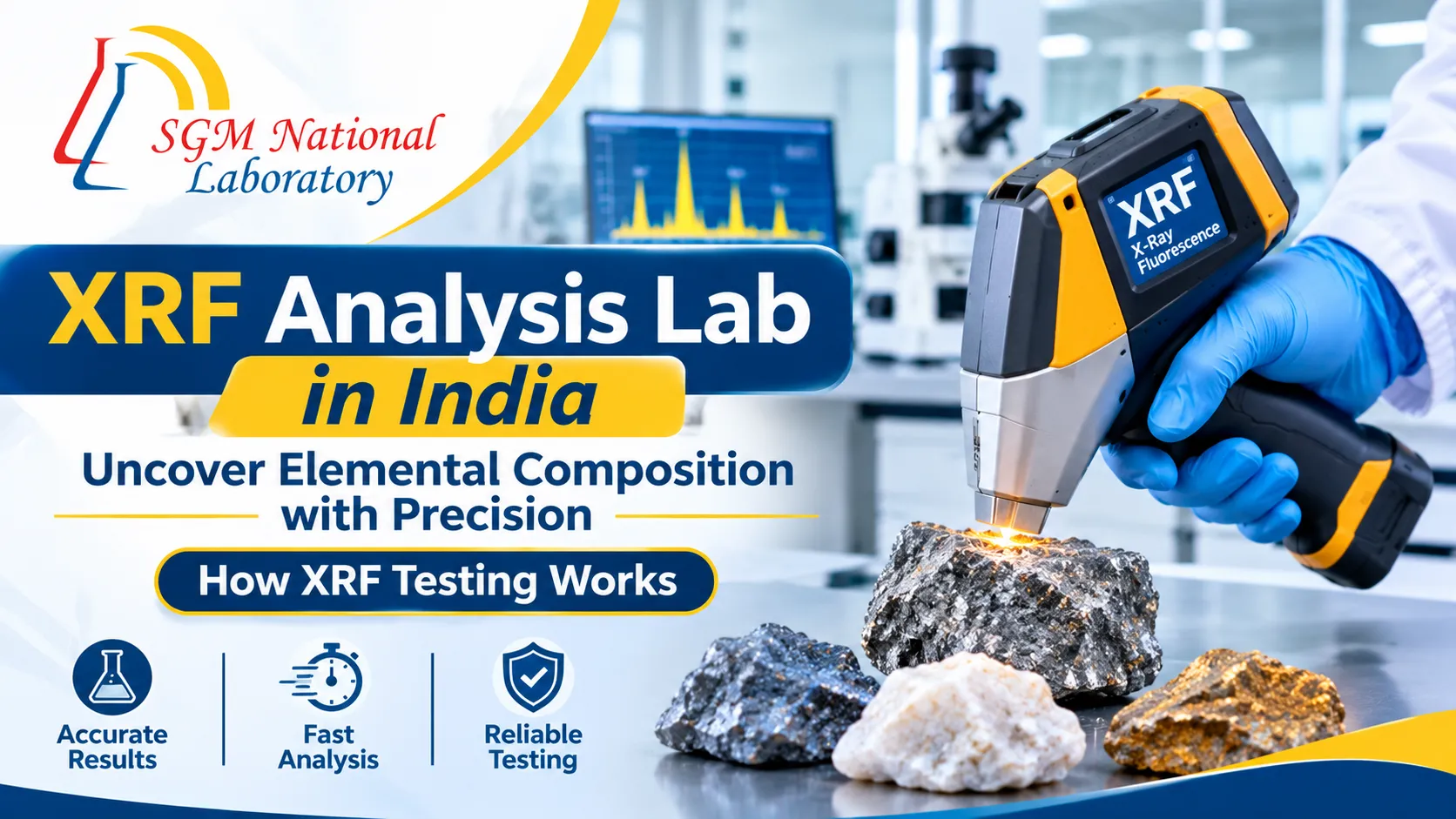
XRF (X-ray fluorescence) hits a sample with X-rays, and each element gives off its own fluorescent X-rays, which the instrument measures to find the composition. It is fast and well suited to oxides in minerals, cement, ceramics and glass. Accuracy depends on calibration and sample preparation.
If you buy or sell limestone, feldspar, quartz, dolomite or cement, you need to know what is in the material, and you need the answer fast. That is why plants send samples to an XRF analysis lab in India before they sign a contract or ship a consignment. This guide explains how XRF works, what it can measure, how it compares with ICP and wet chemistry, and why sample preparation decides how good your result will be.
How Does XRF Testing Work and How Accurate Is It?
XRF is a non-destructive method that reads the elemental make-up of a solid sample, and it is the core test at any XRF analysis lab in India. Every modern chemical analysis laboratory uses it as the first-choice tool for major and minor oxides, because one run can report ten or more oxides in minutes.
The physics in simple steps
- Excitation: An X-ray tube fires high-energy X-rays at the prepared sample.
- Ejection: These X-rays knock electrons out of the inner shells of atoms.
- Fluorescence: Outer-shell electrons drop down to fill the gaps, releasing a secondary X-ray with an energy unique to that element, like a fingerprint.
- Detection: The energy tells us which element is present; the intensity tells us how much.
- Calculation: Software converts intensities into concentrations using a calibration built from certified reference materials (CRMs).
WDXRF and EDXRF
Wavelength-dispersive XRF (WDXRF) separates X-rays using crystals and gives better precision, so it is the standard for cement and mineral quality control. Energy-dispersive XRF (EDXRF) is compact, and handheld units are popular for field screening at mines. Screening is useful, but buyers usually accept results from a calibrated bench instrument at an XRF analysis lab in India.
So, how accurate is XRF?
XRF is very precise, meaning repeat readings agree closely. Accuracy depends on three things:
- Calibration against CRMs that match your material type.
- Sample preparation, which removes grain-size and mineral effects.
- Matrix correction, which accounts for how other elements absorb or boost the signal.
When all three are done properly, a chemical analysis laboratory or XRF analysis lab in India can report major oxides such as CaO, SiO₂ and Al₂O₃ with relative errors of around 1% or better. Standards such as ISO 29581-2 (cement by XRF) and ASTM C114 (performance checks for rapid methods) exist so XRF results can be trusted for trade. Ask any XRF analysis lab in India which reference materials sit behind its calibration.
Which Elements Can XRF Detect?
At an XRF analysis lab in India, most XRF systems measure elements from sodium (Na) to uranium (U). Some WDXRF instruments reach fluorine or boron, but sensitivity drops sharply for the lightest elements.
What XRF reads well
- Major oxides: SiO₂, Al₂O₃, Fe₂O₃, CaO, MgO, Na₂O, K₂O, TiO₂, P₂O₅, MnO
- Sulphur and chlorine: important for cement, gypsum and fuels
- Trace elements: Sr, Zr, Ba, Cr, Ni, Cu, Zn, Pb, usually down to low ppm on pressed pellets
What XRF cannot read directly
- Hydrogen, lithium and beryllium give no usable signal.
- Carbon, nitrogen and oxygen are hard to measure routinely. Oxygen is calculated from the oxide formulas.
- Loss on ignition (LOI), covering water, carbonates and organics, is measured separately by furnace heating and weighing.
Because of these gaps, a reliable chemical testing lab in India pairs XRF with LOI and, where needed, ICP for ultra-trace elements. The report should total close to 100% with LOI included; a total far from 100% is a red flag. A careful XRF analysis lab in India will flag this itself.
XRF vs ICP – Which Is Better?
Neither method wins in every case, and a good chemical testing lab in India will tell you so. XRF is the fast workhorse for major oxides in solids. ICP (ICP-OES or ICP-MS) is the specialist for very low concentrations, but the sample must be dissolved first. Classical wet chemistry is slower but still serves as a referee method. A chemical analysis laboratory with all three can match the method to the question.
XRF vs ICP vs wet chemistry: comparison table
| Factor | XRF | ICP-OES / ICP-MS | Wet Chemistry |
|---|---|---|---|
| Sample Form | Solid (pellet or fused bead) | Liquid (after digestion) | Liquid (after dissolution) |
| Best For | Major and minor oxides | Trace and ultra-trace elements | Referee checks on major elements |
| Detection Range | Low ppm to 100% | ppb to % (ICP-MS reaches lower detection limits) | Roughly 0.1% and above |
| Turnaround Time | Minutes after sample preparation | Longer; digestion takes time | Hours to days |
| Light Elements (Li, Be, B) | Poor or not possible | Good | Possible for some elements |
| Sample Loss Risk | Low; sample is not dissolved | Silica and volatile elements can be lost during digestion | Depends on analyst skill |
| Cost for Full Oxide Panel | Low | Higher | Higher; labour-intensive |
| Common Applications | Cement, limestone, feldspar, glass | Environmental analysis, purity testing, trace metals | Dispute resolution, referee analysis, method validation |
How a chemical testing lab in India chooses
Neither method wins in every case, and a good chemical testing lab in India will tell you so. XRF is the fast workhorse for major oxides in solids. ICP (ICP-OES or ICP-MS) is the specialist for very low concentrations, but the sample must be dissolved first. Classical wet chemistry is slower but still serves as a referee method. A chemical analysis laboratory with all three can match the method to the question.
Does XRF Need Sample Preparation?
Yes. Any XRF analysis lab in India will confirm that handheld XRF can scan a rock as it is, but for lab-grade results, preparation is the biggest factor after calibration. X-rays read only the surface layer of a specimen, so that surface must represent the whole lot.
Typical preparation steps
- Drying at about 105–110 °C, as any chemical testing lab in India does, to remove moisture.
- Crushing and splitting so the test portion represents the full sample.
- Pulverising to fine powder, commonly below 75 microns (200 mesh).
- Making the specimen: a pressed pellet or a fused bead.
- LOI testing on a separate portion for a full oxide balance.
Why skipping prep causes errors
Coarse particles cause what every XRF analysis lab in India calls the particle-size effect, where big grains give a stronger or weaker signal than they should. Different crystal forms of the same compound can also read differently, the mineralogical effect. These errors give no warning; they simply give a wrong number. That is why a serious XRF analysis lab in India records its preparation method on the report, and why a chemical testing lab in India should never skip pulverising to save time.
Pressed Pellet vs Fused Bead – What Is the Difference?
These are the two standard ways a chemical analysis laboratory turns powder into an XRF specimen. Any XRF analysis lab in India should choose between them based on what you need to measure.
Pressed pellet
Fine powder is mixed with a little binder (wax or cellulose) and pressed at roughly 15 to 40 tonnes into a firm disc, often in an aluminium cup.
- Pros: Quick, low cost, no dilution, so it suits trace elements. Sulphur and chlorine stay in the sample.
- Cons: Particle-size and mineral effects remain, so major-oxide accuracy is lower than fusion.
Fused bead
At an XRF analysis lab in India, the sample is mixed with lithium borate flux, often about 1:5 to 1:10, and melted at roughly 1,000–1,100 °C in a platinum crucible, then cast into a glass disc.
- Pros: Removes grain-size and mineral effects, giving the highest accuracy for major oxides. It is preferred for cement, limestone, clay, refractories and glass.
- Cons: The flux dilutes the sample, raising trace detection limits. Volatiles can be partly lost. It takes longer and costs more.
Quick comparison for your chemical analysis laboratory report
| Feature | Pressed Pellet | Fused Bead |
|---|---|---|
| Best for | Traces, sulphur, halogens | Major oxides, top accuracy |
| Matrix effects | Present | Largely removed |
| Dilution | None | Yes (flux) |
| Speed and cost | Faster, cheaper | Slower, costlier |
A good chemical testing lab in India will ask about your end use first. A cement plant checking raw mix needs fused beads; a geologist scanning for trace metals may prefer pellets. A chemical analysis laboratory that explains this choice is one you can trust.
Conclusion
For any chemical testing lab in India, XRF turns X-ray fingerprints into a full oxide profile in minutes, making it the most practical tool for mineral, cement, ceramic and glass testing. Its accuracy is real but not automatic: it comes from matched calibration, careful preparation, the right choice of pellet or bead, and support from LOI and ICP where XRF falls short.
When you compare options for an XRF analysis lab in India, ask how the lab calibrates, which preparation it will use for your material, and whether the report shows LOI and a closing total. A trusted chemical analysis laboratory answers these clearly. A good chemical testing lab in India also explains its results, not just prints them.
If you need dependable oxide results for limestone, quartz, feldspar, dolomite or other industrial minerals, SGM National Lab in Udaipur can help. As a trusted XRF analysis lab in India, we combine XRF with LOI and other methods as a full chemical testing lab in India and chemical analysis laboratory. Choosing the right XRF analysis lab in India starts with one sample, so send yours today.
Frequently Asked Questions
X-ray fluorescence excites a sample with X-rays and reads the characteristic energy each element gives off, which reveals the composition.
Powders, pressed pellets, fused beads, solids and some liquids, such as ores, cement raw materials, ceramics, metals and soils.
For solids it is generally non-destructive, though powders are usually ground and pressed, and fusion methods change the sample form.
Very light elements are hard to measure and results depend on sample preparation. Elements such as carbon usually need other methods.
With proper calibration and sample preparation, XRF is precise for major and minor elements. Trace-level work may need other techniques such as ICP.
Use it for specific constituents, for moisture, or when a result needs verification. Labs often combine XRF with wet chemistry.
Share the material, expected elements, the reporting format (elements or oxides) and the purpose, such as a grade check or a contract dispute.