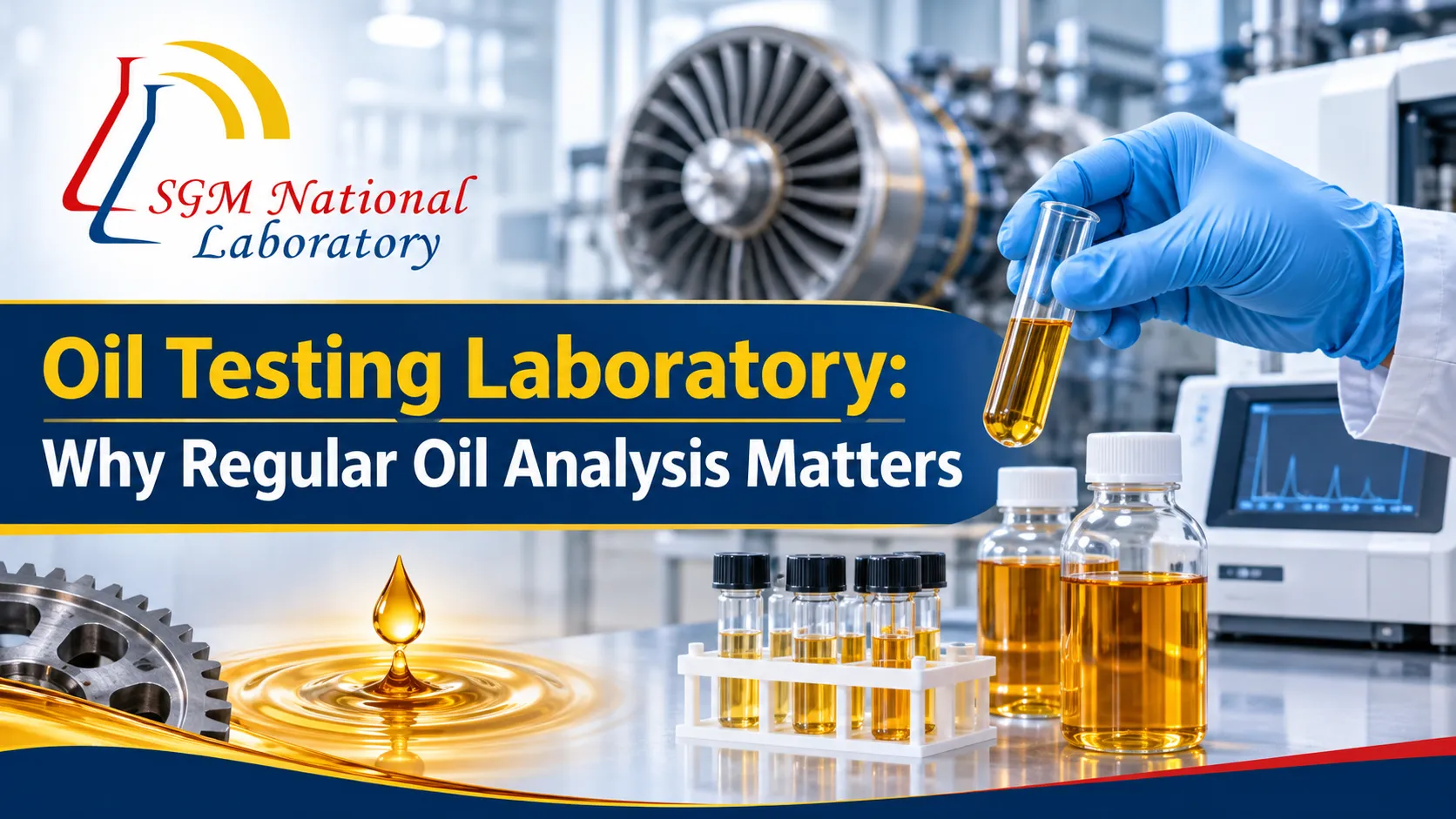
Most machine breakdowns don’t happen out of nowhere. A bearing starts to wear, a seal begins to leak, or dust gets past a filter, and the oil carries the evidence for weeks before anything fails. An oil testing laboratory reads that evidence. Send in a small sample and you learn what’s happening inside an engine, gearbox or hydraulic system without opening it up.
For plants, fleets and power units across India, this has become one of the cheapest ways to protect expensive equipment. Below, we explain what an oil analysis lab in India actually tests, how often you should sample, and how the results turn into decisions on the shop floor.
Why Is Oil Analysis Important for Machines?
Oil analysis shows the condition of both the oil and the machine. Tests for viscosity, water, acid number, contamination and wear metals show when oil needs changing and give early warning of wear, leaks or overheating. Regular testing cuts breakdowns and avoids changing good oil too early.
Think of it as a blood test for your equipment. A doctor doesn’t wait for a heart attack to check cholesterol, and a maintenance team shouldn’t wait for a pump to seize before checking its oil.
It tells you about the oil itself
Lubricants break down with heat, time and load. Additives get used up, the oil thickens or thins, and acids build up. An oil testing laboratory measures these changes, so you change oil when it is actually worn out, not just because the calendar says so. Many plants find they have been draining perfectly usable oil for years.
It tells you about the machine
The same sample also carries tiny metal particles, dirt and moisture. These point to which part is wearing and why. That is the real value: the oil becomes a report on the health of the whole system.
What Does an Oil Analysis Test Check?
A standard test package from an accurate oil testing lab covers a handful of core checks. Each one answers a different question. Here is how we explain it to our clients:
| Test | What It Tells You | Action to Take |
|---|---|---|
| Viscosity (at 40°C / 100°C) | Whether the oil is still the right thickness, or has been mixed, sheared, or oxidised. | If it is more than ±10% away from the new-oil value, check for the wrong top-up oil or overheating; plan an oil change. |
| Water Content (Karl Fischer / Crackle) | Moisture from leaks, condensation, or washdown. | Find the water source, check coolers and seals, and dry or replace the oil. |
| Total Acid Number (TAN) | How far the oil has oxidised and aged. | A rising TAN means the oil is near end of life; schedule a change before sludge forms. |
| Total Base Number (TBN, Engines) | How much acid-fighting reserve is left in engine oil. | Low TBN means shorten drain intervals or check fuel quality. |
| Particle Count / ISO Cleanliness | Level of dirt and solid particles. | Improve filtration, check breathers and seals, and flush if needed. |
| Wear Metals (Fe, Cu, Pb, Al, Cr, Sn) | Which components are wearing and how fast. | Compare with past trends; inspect the part linked to the rising metal. |
| Contaminants (Si, Na, K) | Dust getting in, or coolant/glycol leaks. | Check air filters and intake; pressure-test the cooling system. |
| Flash Point / Fuel Dilution | Fuel leaking into engine oil. | Inspect injectors and the fuel system; change the oil. |
Physical and chemical tests
Viscosity, water, TAN and TBN describe the oil’s own condition. They decide whether the lubricant is still fit to use.
Contamination tests
Particle count, silicon and sodium readings show what has got into the oil from outside. Dirt is the biggest single cause of hydraulic failure, so this part matters a lot.
Wear tests
Spectroscopy picks up metals in parts per million. This is where an oil testing laboratory moves from checking oil to predicting machine problems.
How Often Should I Test Engine or Hydraulic Oil?
There is no single number for every machine. It depends on how critical the equipment is, how hard it runs and where it works. Still, these are the starting points we suggest at our oil testing laboratory, and they work for most sites.
Engine oil
For diesel engines in trucks, gensets and earthmoving machines, sample at every oil change, or roughly every 250 running hours. Dusty sites like mines and quarries may need more frequent checks.
Hydraulic oil
Hydraulic systems are sensitive to dirt and water, so test them every 500 hours or at least once a quarter. Injection moulding machines, presses and mobile hydraulics all fall here.
Gearboxes, compressors and turbines
Industrial gearboxes can usually go 500 to 1,000 hours between samples. Turbines and transformers, where failure is very costly, are often tested every three months as part of a planned programme.
Consistency matters more than frequency
A single report gives you a snapshot. The real insight comes from trends. Always sample from the same point, with the machine warm and running, and send samples to the same oil analysis lab in India each time so results can be compared fairly.
What Do Wear Metals in Oil Mean?
Wear metals are the fingerprints of damage. Each metal usually comes from a specific part, so when an oil testing laboratory reports a rising reading, it points you toward where to look.
Common metals and their likely sources
- Iron (Fe): cylinders, gears, shafts, bearings. The most common wear metal.
- Copper (Cu): bushings, thrust washers, cooler tubes. A sudden jump can also mean a cooler leak.
- Lead (Pb) and tin (Sn): bearing overlays in engines.
- Aluminium (Al): pistons, pump housings, some bearings.
- Chromium (Cr): piston rings and plated shafts.
Trend beats a single number
A reading of 40 ppm iron might be normal for one engine and alarming for another. What matters is the change. If iron sits around 15 ppm for six samples and then jumps to 45, something has changed, even if 45 looks “acceptable” on paper. A good lab will flag that jump and tell you what it likely means.
Can Oil Analysis Predict Machine Failure?
Yes, in many cases, and that is the main reason maintenance teams use it. Most mechanical failures go through a slow stage of wear before the final breakdown. Oil analysis can catch that stage weeks or even months ahead.
What early warnings look like
A rise in silicon followed by rising iron and aluminium often means dust is entering through a damaged air filter and wearing the engine. Fixing a ₹500 filter at that stage can save a full overhaul. In the same way, rising copper plus water in a hydraulic sample often points to a leaking cooler long before the system overheats.
What it cannot do
Oil analysis is not magic. It won’t catch sudden failures like a snapped bolt or an electrical fault, and standard spectroscopy can sometimes miss very large wear particles. That is why serious programmes combine it with vibration analysis and routine inspections. Together, these tools give a much clearer picture than any one method on its own.
How to Choose an Accurate Oil Testing Lab
Results are only as good as the lab producing them. A wrong reading can lead to an unnecessary teardown or, worse, a missed warning. Here is what to look for in an oil testing laboratory.
Testing standards and equipment
The lab should follow recognised ASTM or IS test methods and use calibrated instruments such as spectrometers, viscometers and Karl Fischer titrators. Ask which method they use for each test.
Clear, practical reports
A report full of numbers with no explanation doesn’t help a plant engineer at 7 a.m. Look for reports that show trends, mark results as normal, caution or critical, and give a plain recommendation.
Turnaround time and support
Fast results matter when a machine is under suspicion. A responsive oil analysis lab in India should also be willing to talk you through a report and help set alarm limits for your equipment.
At SGM National Lab, our team handles engine, hydraulic, gear, turbine and transformer oils with this approach in mind. If you are looking for a reliable oil testing laboratory in India, you can see our full range of tests and sampling guidance on our service page
Conclusion
Oil carries a running record of what’s happening inside your machines. Regular testing turns that record into useful decisions: when to change oil, where wear is starting, and which fault to fix before it becomes a breakdown. A sample costs very little next to a failed gearbox or a day of lost production.
Start simple. Pick your most critical machines, sample them on a fixed schedule, and work with an accurate oil testing lab that gives you clear trends, not just numbers. In a few months you will know your equipment far better, and your maintenance budget will thank you. When you’re ready to begin, an experienced oil testing laboratory like SGM National Lab can help you build a programme that fits your plant
FAQS
It tests a lubricant sample to judge the condition of the oil and the machine, using results for viscosity, contamination and wear metals.
Typical tests include viscosity, water content, acid number, flash point, wear metals, additive elements and particle contamination.
Rising wear metals, water or soot give early warning of problems, so maintenance can be planned before a failure.
It depends on the machine and duty. Many plants sample at fixed running-hour or calendar intervals, and critical equipment is tested more often.
Yes. If the oil is still within limits you can avoid unnecessary changes, while degraded oil is replaced before it causes damage.
Sample from a warm, running machine at a consistent point using a clean bottle. Label it with machine ID, oil grade and operating hours.
Power, mining, cement, steel, transport and manufacturing plants that run engines, gearboxes, compressors, hydraulics and turbines.