
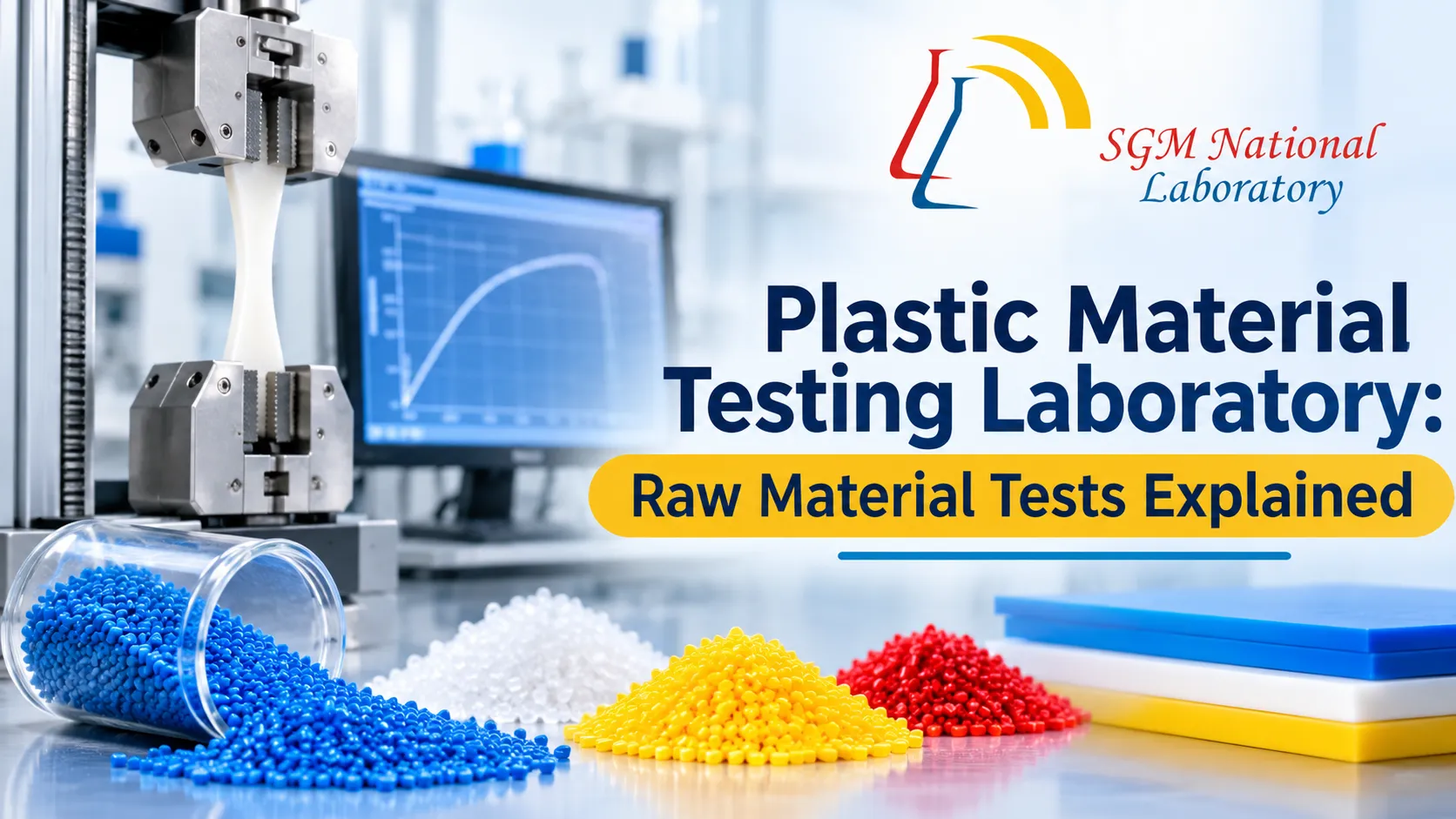
Ask any moulding plant manager about their worst week and you’ll probably hear about a bad batch of granules. The parts looked fine coming off the machine. Then the customer called. The caps were cracking, or the crates had gone brittle, or the colour drifted halfway through the order.
Most of those headaches start with the raw material, and most of them could have been caught early. That’s the whole reason a plastic material testing laboratory exists. We check the resin before it ever reaches your hopper.
Below, we walk through the tests we actually run at our plastic material testing laboratory in Udaipur, what the numbers mean, and how to use them with your suppliers
What Does a Plastic Material Testing Laboratory Do?
Put simply, a plastic material testing laboratory measures how a polymer behaves. How does it flow? How much load can it take? When does it soften? What’s actually inside the bag?
Most of our day goes into plastic raw material testing, which means checking granules, powders, and compounds before they’re processed. It’s cheaper to reject a few bags of resin than a truckload of finished parts.
Some questions need chemistry, though, like which additives are present or whether a pigment carries lead. That’s why it helps when the plastic lab and the chemical testing laboratory sit under one roof, as they do at SGM.
Who Sends Us Samples?
Our plastic material testing laboratory gets samples from a real mix of people. Moulders checking a new supplier’s PP against the datasheet. Pipe makers who can’t afford a failure five years down the line. Packaging firms working to BIS specs. Recyclers proving their granules are what they claim. And traders who want plastic raw material testing done before they release payment.
Why Not Just Test the Finished Product?
You should test that too. But by the time a finished part fails, you’ve already paid for resin, machine hours, and labour. Plastic raw material testing catches the problem when it’s still a supplier issue, not your issue.
The Main Plastic Raw Material Tests, One by One
No single test tells you everything. A good plastic material testing laboratory will help you pick the few that matter for your product, not run the full menu.
Melt Flow Index (MFI)
If we could run only one test in plastic raw material testing, this would be it. MFI tells you how many grams of molten plastic pass through a small die in ten minutes under a fixed weight and temperature (ASTM D1238, ISO 1133).
A high number suits thin-walled injection moulding. A low number suits pipes, film, and blow moulding. When a supplier’s MFI wanders from lot to lot, your process settings wander with it.We see this a lot with recycled PP and HDPE, where two bags from one lot can read quite differently. That usually means mixed grades or over-processed material.
Density
Density (ASTM D792, ISO 1183) sounds boring, but it’s one of the cheapest checks in plastic raw material testing and catches a surprising amount. It’s the quickest way to tell HDPE from LDPE. It also gives away extra filler. If a PP compound comes in heavier than it should, there’s a good chance someone added more calcium carbonate than they declared.
Tensile, Flexural, and Impact Strength
For these, our plastic material testing laboratory moulds the raw material into standard test bars and then pulls, bends, or strikes them.
Tensile testing (ASTM D638, ISO 527) shows how much pulling force the plastic takes before it stretches or snaps. Flexural testing (ASTM D790, ISO 178) shows how stiff it is when bent. Izod and Charpy impact tests (ASTM D256, ISO 180, ISO 179) show how it handles a sudden knock. We often add a Shore hardness check (ASTM D2240) as well.
Thermal Tests: DSC, HDT, and TGA
A part that’s fine at room temperature can sag inside a hot car.
DSC (ASTM D3418, ISO 11357) gives us the melting point, crystallinity, and glass transition temperature. HDT (ASTM D648, ISO 75) tells you the temperature at which a test bar starts to bend under load, which matters for anything near a motor or hot water. TGA tracks weight loss on heating, showing stability and filler content.
Moisture and Ash Content
Nylon, PET, PBT, and polycarbonate soak up moisture from the air. Mould them wet and you get silver streaks, bubbles, and weak parts. A quick moisture check at a plastic material testing laboratory before drying saves a lot of grief.
Ash content (ASTM D5630, ISO 3451) is just as simple. We burn off the polymer and weigh what’s left. That residue is your filler, whether it’s talc, glass fibre, or calcium carbonate. If you’re paying for 30% glass-filled nylon, this is how you check you’re getting 30%. It’s one of the oldest methods in any chemical testing laboratory.
FTIR Polymer Identification
FTIR reads how a sample absorbs infrared light. Every polymer leaves its own pattern, a bit like a fingerprint. This is where plastic testing starts to look like the work of a chemical testing laboratory.
We use it to confirm whether a sample is really PP or PE, ABS or polystyrene, and to spot contamination in recycled lots. Paired with DSC, it gives a chemical testing laboratory solid evidence of what a material is.
Chemical Resistance and Composition
Will the plastic survive contact with engine oil, detergent, or a mild acid? Chemical resistance testing (ASTM D543) in our chemical testing laboratory answers that. We soak the samples, then check for swelling, cracking, and loss of strength.
Composition testing goes a step further. Using XRF, AAS, or ICP-MS, a chemical testing laboratory can measure heavy metals like lead, cadmium, and chromium. If you make toys, food containers, or anything for export, this isn’t optional.
Flammability
For electrical housings and car interiors, a plastic material testing laboratory runs UL 94 or ASTM D635 tests to see how fast a flame spreads, whether it self-extinguishes, and whether it drips.
Weathering and Environmental Stress
At a plastic material testing laboratory, weathering chambers (ASTM G154 is a common method) speed up UV, rain, and heat cycles, so you can see fading or cracking in weeks instead of years. It’s worth doing for water tanks, agricultural film, and outdoor pipes.
The Main Plastic Raw Material Tests, One by One
| Test | What It Tells You | Common Standards |
|---|---|---|
| Melt Flow Index | How easily the melt flows | ASTM D1238, ISO 1133 |
| Density | Grade and filler level | ASTM D792, ISO 1183 |
| Tensile | Pulling strength and stretch | ASTM D638, ISO 527 |
| Flexural | Stiffness when bent | ASTM D790, ISO 178 |
| Impact | Toughness against a knock | ASTM D256, ISO 180 |
| DSC | Melting point and blends | ASTM D3418, ISO 11357 |
| HDT | Heat resistance under load | ASTM D648, ISO 75 |
| Ash Content | Filler percentage | ASTM D5630, ISO 3451 |
| FTIR | Polymer identity | ASTM E1252 |
| Flammability | How it burns | UL 94, ASTM D635 |
Which Plastics Can Be Tested?
Pretty much anything in granule, powder, or flake form. At our plastic material testing laboratory we regularly see PP, PE, HDPE, LDPE, PVC, and PET, along with engineering grades like ABS, nylon, polycarbonate, PBT, and acetal. Masterbatches, compounds, additives, and recycled regrind come in too.
The right tests depend on the material. With PVC we look closely at heat stability and composition. With nylon, moisture and strength come first. For recycled grades, plastic raw material testing usually starts with MFI, density, ash, and FTIR, because those four reveal most problems quickly.
How to Pick the Right Plastic Material Testing Laboratory
A cheap report isn’t worth much if you can’t trust the numbers. Check a few things first.
Ask Which Standards They Follow
Any plastic or chemical testing laboratory you work with should test to named ASTM, ISO, or BIS methods and print the method on the report. SGM National Laboratory runs its plastic raw material testing under an ISO 9001:2015 certified quality system.
Look at the Equipment
A capable plastic material testing laboratory needs both sides: physical testing machines (MFI tester, universal testing machine, impact tester) and analytical instruments (DSC, TGA, FTIR). If the same lab also does elemental analysis with XRF or ICP-MS, one sample covers both.
Check the Turnaround
Routine plastic raw material testing like MFI, density, and ash usually takes a few working days. Mechanical and thermal work takes a bit longer because the specimens have to be moulded and conditioned first.
See What the Report Looks Like
A good report lists the sample details, the test method, the conditions, and the results with units. It’s signed by the analyst. A plastic material testing laboratory that only writes “pass” or “fail” isn’t giving you much to work with.
How Testing Works at Our Plastic Material Testing Laboratory
Our plastic raw material testing process is straightforward. You tell us what the material is, what it’s going into, and what you’re worried about. If you’re not sure which tests you need, we’ll suggest a sensible set.
Then you courier the sample from anywhere in India, and we confirm the quantity needed. Specimens are moulded or conditioned to the standard, physical tests run in the polymer section, and any composition or heavy metal work goes to our chemical testing laboratory. You get a full report with methods, results, and our remarks.
For the complete list of polymer tests and materials we cover, see our plastic material testing laboratory page.
Problems We Catch Most Often
Some issues turn up at our plastic material testing laboratory again and again. The wrong grade gets supplied, and the MFI gives it away. The filler level is higher than the datasheet says, and the ash test shows it. Nylon arrives damp. A recycled lot has two polymers mixed together, and the DSC shows two melting peaks. A pigment carries heavy metals above the permitted limit.
None of these are hard to find. Someone just has to look before production starts.
About SGM National Laboratory
SGM National Laboratory is an industrial and mineral testing lab in Udaipur, Rajasthan, and a sister concern of Rajasthan Mineral Laboratory. Polymer testing and our chemical testing laboratory share one facility, so one sample can cover both.
You can reach us at 315, Opp. Akashwani Kendra, Surya Nagar, Udai Nivas Road, MIA Madri, Udaipur-313001. Our testing unit is at Opp. Saloni Weight Bridge, Avarimata Main Road, RIICO Industrial Area, Gudli, Th. Mavli, Udaipur. Call +91 733 988 7937 or +91 995 097 7937, or email sgmnationallab@gmail.com. We’re open Monday to Saturday, 10 AM to 6 PM.
Conclusion
Good plastic products start with good raw material, and the only way to know what you’re buying is to have a plastic material testing laboratory check it. You rarely need every test. You do need the right ones.
A dependable plastic material testing laboratory gives you the numbers to hold suppliers to their promises, keep your batches consistent, and meet BIS and export requirements without surprises. Regular plastic raw material testing, with a chemical testing laboratory on hand for the harder questions, takes the guesswork out of buying resin.
If you’d like a second opinion on a supplier, a recycled lot, or a new compound, get in touch with our team in Udaipur. Tell us what you’re making, and we’ll tell you what to test.
FAQS
It checks resins, masterbatches and compounds for composition and quality before they go into production.
Ash or filler content, moisture, density and composition checks.
Filler level affects cost, strength and finish. Verifying it ensures the compound meets the specification.
Moisture can cause defects such as bubbles and surface marks during processing.
Recycled material can be checked for ash, moisture and contamination-related parameters. Mention the grade.
Properties such as tensile, impact or melt flow need specialised equipment. Confirm availability with the lab.
Send pellets or granules in a sealed bag with the grade, supplier and required tests.