SGM National Laboratory

Soil Testing Laboratory vs Chemical Testing Lab

Laboratory testing plays a vital role across modern industries, helping organizations make informed decisions in areas such as agriculture, manufacturing, environmental management, and quality assurance. The data generated through laboratory analysis can significantly influence crop productivity, product quality, operational efficiency, and environmental safety. Despite their importance, many people often confuse soil testing laboratories with chemical testing laboratories because both involve sample analysis and technical reporting. However, when comparing a Soil Testing Laboratory vs Chemical Testing Lab, it becomes clear that these facilities serve different purposes and are designed to address distinct testing requirements.

A soil testing laboratory primarily focuses on analyzing soil properties, including nutrient levels, pH balance, fertility status, and overall soil health. The information obtained from soil testing helps farmers, landscapers, agricultural consultants, and land developers understand the condition of the soil and make informed decisions regarding crop selection, fertilizer application, and land management. In contrast, a chemical testing lab evaluates a wide range of materials, including chemicals, water, food products, pharmaceuticals, fertilizers, and consumer goods. Its primary objective is to determine composition, purity, safety, performance, and compliance with quality standards.

Understanding the difference between soil and chemical testing is essential when selecting the right laboratory service. Choosing the appropriate laboratory ensures accurate results, supports cost-effective decision-making, and helps organizations meet regulatory requirements. In this guide, we will explore the key differences between a Soil Testing Laboratory vs Chemical Testing Lab, their applications, benefits, and the factors to consider when choosing a laboratory. While both types of testing are critical for ensuring quality, safety, and performance, each serves a unique purpose and provides valuable insights for different industries and applications.

Soil Testing Laboratory vs Chemical Testing Lab

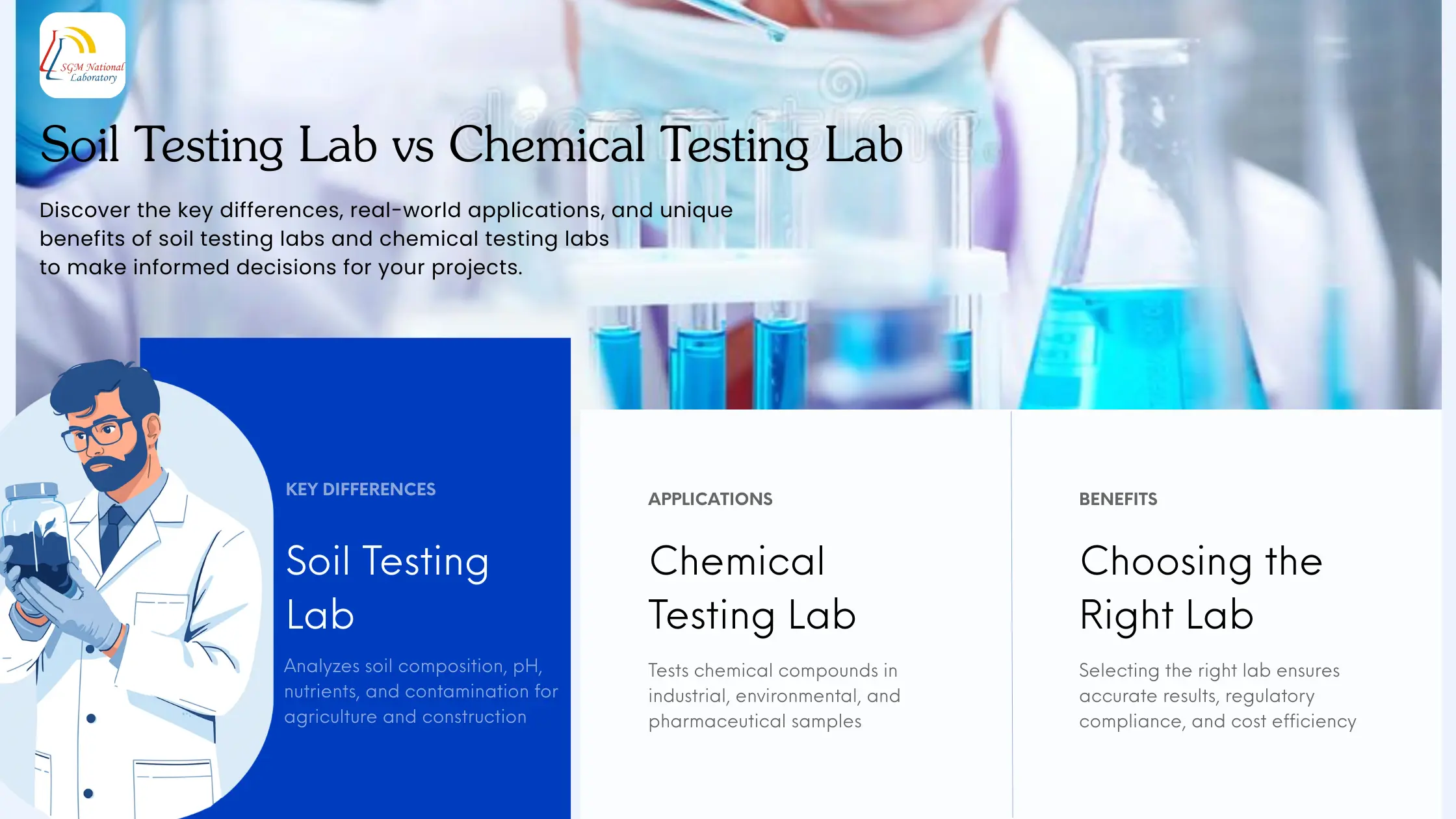
Although both laboratories perform scientific analysis and provide detailed reports, they serve different purposes and address different testing requirements. A Soil Testing Laboratory vs Chemical Testing Lab comparison shows that soil testing focuses on evaluating soil health, fertility, nutrient levels, and land suitability, while chemical testing is concerned with analyzing the composition, purity, safety, and quality of various materials and products. Understanding these differences helps farmers, manufacturers, businesses, and environmental professionals choose the right testing service for their specific needs, ensuring accurate results and informed decision-making.

Understanding a Soil Testing Laboratory

What Is a Soil Testing Laboratory?

A Soil Testing Laboratory is a specialized facility that analyzes soil samples to determine their physical, chemical, and biological properties. When comparing a Soil Testing Laboratory vs Chemical Testing Lab, it is important to understand that a soil testing laboratory focuses specifically on evaluating soil health, nutrient availability, fertility levels, and overall land suitability. The primary purpose of a soil testing laboratory is to provide accurate information about soil conditions so that users can make informed decisions regarding agriculture, landscaping, environmental management, and construction projects.

Soil plays a vital role in supporting plant growth, maintaining environmental balance, and ensuring the success of land development activities. The condition of the soil directly affects crop productivity, water retention, and land performance. Unlike a Soil Testing Laboratory vs Chemical Testing Lab comparison, where chemical testing focuses on product composition and quality, soil testing is concerned with understanding the characteristics of the soil itself. Since soil properties can vary significantly from one location to another, laboratory analysis is often necessary to obtain reliable and site-specific information.

A professional soil testing laboratory uses advanced testing methods and modern analytical equipment to evaluate various soil parameters. These may include nutrient content, pH levels, salinity, organic matter, and micronutrient concentrations. Understanding the differences highlighted in a Soil Testing Laboratory vs Chemical Testing Lab assessment helps users select the most appropriate testing service for their needs. The data generated by a soil testing laboratory enables farmers, landowners, developers, and environmental professionals to make decisions based on scientific evidence rather than assumptions.

The information provided by a soil testing laboratory supports better crop planning, efficient fertilizer use, improved soil management, and sustainable land utilization. As discussed throughout the Soil Testing Laboratory vs Chemical Testing Lab comparison, choosing the right laboratory ensures accurate results and helps achieve long-term productivity, quality, and environmental sustainability.

Parameters Commonly Tested in Soil Analysis

soil testing labs offer many testing services.. Some parameters are commonly checked.

Soil pH

Soil pH measures how acidic or alkaline the soil is. This affects availability and plant growth. Some crops do well in acidic soils. Others do better in alkaline conditions.

Electrical Conductivity (EC)

EC measures the salts in the soil. Much salt can hurt plant growth and reduce crop yields.

Organic Matter Content

Organic matter helps soil fertility, water retention and microbial activity. It shows soil quality and productivity.

Macronutrients

Soil testing labs often analyze nutrients like:

* Nitrogen (N)

* Phosphorus (P)

* Potassium (K)

These nutrients are crucial for plant growth and farming productivity.

Micronutrients

Soil analysis may also include micronutrients like:

* Zinc

* Iron

* Copper

* Manganese

* Boron

These nutrients are needed in amounts but are important, for plant health.

Industries That Use Soil Testing Services

Soil testing is used in many areas beyond farming.

* Agriculture and Farming

Farmers use soil analysis to find nutrient deficiencies, optimize fertilizer use and improve crop yields. They rely on soil testing to grow crops.

* Horticulture

Nurseries, greenhouses and horticultural businesses use soil testing to keep plants and flowers healthy.

* Landscaping

Landscape designers and property developers use soil analysis to ensure lawns, gardens and green spaces grow well.

* Environmental Management

Environmental professionals use soil testing to check for contamination and monitor soil quality in restoration projects.

* Construction and Infrastructure

Construction companies evaluate soil characteristics before projects. Soil data helps determine if land is suitable and what foundation is needed.

Why Soil Testing Matters

Without analysis landowners and businesses may make decisions based on incomplete information. This can lead to overuse of fertilizers, poor crop selection, soil degradation and costly project delays.

A professional Soil Testing Laboratory provides data. This supports resource management, sustainable practices and better long-term outcomes. By understanding soil conditions stakeholders can improve productivity while reducing costs and environmental impacts. Soil testing helps make decisions. Soil conditions should be understood before taking action.


Conclusion

The choice between a Soil Testing Laboratory and a Chemical Testing Lab ultimately depends on what you want to know and the type of sample being tested. While both laboratories use scientific methods, advanced instruments, and standardized procedures to generate reliable results, their objectives are quite different. A Soil Testing Laboratory focuses on understanding soil health, nutrient availability, fertility levels, and land suitability. This information is essential for agriculture, landscaping, environmental management, and construction projects, where the condition of the soil can directly affect productivity, sustainability, and project success.

In contrast, a Chemical Testing Lab evaluates the composition, purity, safety, and performance of various materials and products. These laboratories play a critical role in industries such as pharmaceuticals, food processing, cosmetics, fertilizers, chemicals, and manufacturing. By identifying contaminants, verifying product quality, and ensuring compliance with regulatory standards, chemical testing helps businesses maintain consistency, protect consumers, and reduce operational risks.

Understanding the difference between soil testing and chemical testing enables individuals and organizations to select the most appropriate laboratory service for their specific requirements. Choosing the right laboratory not only improves the accuracy of results but also supports better decision-making, cost savings, quality assurance, and regulatory compliance. Whether the goal is to improve crop yields, assess land conditions, validate product quality, or ensure environmental safety, professional laboratory testing provides the data needed to make confident and informed decisions.

Leave a Reply

Your email address will not be published. Required fields are marked *