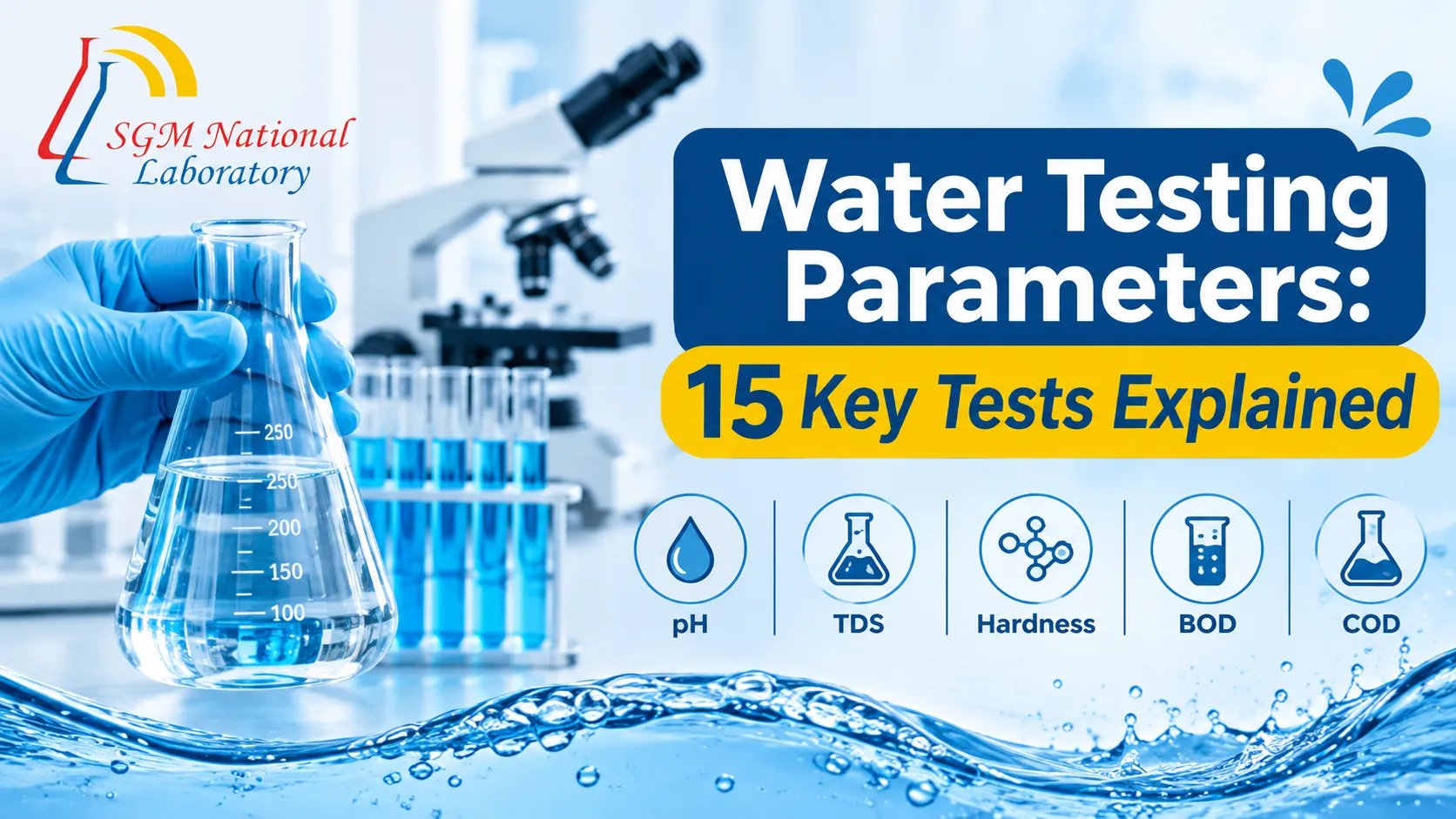
A standard water test checks physical parameters (pH, turbidity, TDS, colour), chemical parameters (hardness, chloride, sulphate, nitrate, fluoride, iron), heavy metals such as lead and arsenic, and microbiology (coliform, E. coli). Results are compared with IS 10500 for drinking water or CPCB norms for wastewater.
Most people get their water tested only after something goes wrong. The RO starts making a noise, clothes come out of the wash with yellow patches, or someone at home keeps getting stomach problems. Very few test before they start using a new borewell or tank.
The trouble is that clear water is not always safe water. Fluoride, nitrate and arsenic don’t change the colour or taste. Bacteria can’t be seen. So the only real way to know is to send a sample to a lab and check it against the right standard.
This article explains the main water testing parameters a lab looks at, what the limits are under IS 10500, and what a high or low result actually means for you.
What Are Water Testing Parameters?
A water testing parameter is simply one thing the lab measures in your sample. pH is one parameter. TDS is another. E. coli is another. Each one tells you something different, and no single number can tell you whether water is safe.
It works a bit like a blood test report. Your doctor doesn’t look only at sugar. They look at a full panel and read the results together. A water report is read the same way.
For drinking water in India, labs compare results with IS 10500:2012, the standard published by the Bureau of Indian Standards. Most parameters have two limits. The acceptable limit is where your water should be. The permissible limit is a relaxation that applies only when there is no other source of water available. If a result crosses the permissible limit, that water should not be used for drinking.
15 Key Water Testing Parameters and Their IS 10500 Limits
The table below covers the 15 parameters that come up most often in drinking water reports.
| S. No. | Parameter | Unit | Acceptable Limit | Permissible Limit (No Alternate Source) |
|---|---|---|---|---|
| 1 | pH | – | 6.5 to 8.5 | No relaxation |
| 2 | Turbidity | NTU | 1 | 5 |
| 3 | Total Dissolved Solids (TDS) | mg/L | 500 | 2000 |
| 4 | Colour | Hazen units | 5 | 15 |
| 5 | Total Hardness (as CaCO3) | mg/L | 200 | 600 |
| 6 | Total Alkalinity (as CaCO3) | mg/L | 200 | 600 |
| 7 | Chloride | mg/L | 250 | 1000 |
| 8 | Sulphate | mg/L | 200 | 400 |
| 9 | Nitrate (as NO3) | mg/L | 45 | No relaxation |
| 10 | Fluoride | mg/L | 1.0 | 1.5 |
| 11 | Iron | mg/L | 0.3 | No relaxation |
| 12 | Lead | mg/L | 0.01 | No relaxation |
| 13 | Arsenic | mg/L | 0.01 | 0.05 |
| 14 | Total Coliform | per 100 mL | Not detectable | Not detectable |
| 15 | E. coli | per 100 mL | Not detectable | Not detectable |
Physical Parameters
1. pH
pH tells you if the water is acidic or alkaline. For drinking, it should be between 6.5 and 8.5. Acidic water slowly corrodes pipes and fittings and can pick up metals on the way to your tap. Water with very high pH tastes bitter and leaves scale.
2. Turbidity
Turbidity is how cloudy the water is. It is caused by fine silt, clay or organic matter. Apart from looking bad, cloudy water is harder to disinfect, because bacteria can stay protected inside the particles.
3. Total Dissolved Solids (TDS)
TDS is the total amount of salts and minerals dissolved in the water. It mostly decides how the water tastes. We’ll come back to TDS in more detail below, since it’s the number people ask about most.
4. Colour
Drinking water should have no visible colour. A yellow or brownish tint usually means organic matter, iron or manganese. Even if it isn’t harmful by itself, colour often points to a bigger problem in the source or pipeline.
Chemical Parameters
5. Total Hardness
Hardness comes from calcium and magnesium. It is not a health risk, but it causes white scale in geysers, kettles and taps, and makes soap hard to lather. It also shortens the life of RO membranes and boilers.
6. Total Alkalinity
Alkalinity is the water’s capacity to neutralise acid. It doesn’t matter much for health. It matters when you are designing a treatment system, because it affects how stable the pH stays.
7. Chloride
High chloride makes water taste salty and adds to corrosion. If chloride goes up suddenly in a well that was fine earlier, it can be a sign of sewage or saline water getting in.
8. Sulphate
Too much sulphate gives a bitter taste and can cause loose motions, especially in people who are new to that water. It is found naturally in some soils and rock types.
9. Nitrate
Nitrate gets into groundwater from fertilisers, septic tanks and cattle waste. It is particularly harmful for infants, so IS 10500 gives no relaxation above 45 mg/L. In farming areas, this test should never be skipped.
10. Fluoride
Small amounts of fluoride are good for teeth. Higher amounts cause dental fluorosis (stained, pitted teeth), and over many years, skeletal fluorosis, which affects bones and joints. Groundwater in many parts of Rajasthan, Gujarat, Telangana and Andhra Pradesh has high fluoride, so borewell users in these areas should test for it.
11. Iron
Iron is behind the orange stains on buckets, tiles and white clothes. It also gives a metallic taste and helps iron bacteria grow inside pipes. It is one of the most common complaints with borewell water.
Heavy Metals
12. Lead
Lead is toxic even at very low levels, and children are affected the most. It usually comes from old pipes, soldered joints or low-quality fittings, not from the source. That is why it’s better to test lead at the tap you actually drink from.
13. Arsenic
Arsenic occurs naturally in some aquifers, especially in the Gangetic plains. You can’t see, smell or taste it. Drinking it over a long period is linked to skin lesions, cancer and heart disease.
Microbiological Parameters
14. Total Coliform
Coliform bacteria are used as an indicator. If they show up, it means contamination has entered somewhere, maybe through a leaking pipe, an open tank or a failed treatment step.
15. E. coli
E. coli comes from human or animal faeces. If it is found in a drinking water sample, the water is not safe to drink until the cause is fixed and the water is tested again.
If your water is chlorinated, the lab will usually check residual free chlorine as well. IS 10500 asks for at least 0.2 mg/L at the consumer end.
What Is the Safe TDS Level for Drinking Water in India?
As per IS 10500, TDS up to 500 mg/L is acceptable for drinking. Up to 2000 mg/L is allowed only when there is no other water source.
As a rough idea, water below 300 mg/L usually tastes good. Between 300 and 500 it is fine for daily use. Once it goes above 500 you start to notice the taste, and above 1000 most people find it salty or bitter.
Two things are worth knowing here. First, very low TDS is not better. Many RO purifiers bring TDS down to 30 or 40 mg/L, which removes useful minerals too. Second, a TDS meter only shows the total. Water with a normal TDS reading can still have high fluoride, nitrate or bacteria. A home meter is useful, but it is not a replacement for a lab test.
Which Tests Are Required as per IS 10500?
IS 10500 covers far more than the 15 parameters in our table. The full standard includes:
- Physical and taste-related parameters like colour, odour, taste, pH, turbidity and TDS
- General chemical parameters such as hardness, chloride, nitrate, fluoride, iron, manganese, copper and zinc
- Toxic substances like lead, arsenic, mercury, cadmium, chromium and cyanide
- Pesticide residues and radioactive substances
- Bacteriological tests for total coliform and E. coli
For most homes and offices, a routine package covering the basic physical, chemical and bacteria tests is enough. A complete IS 10500 analysis is needed for packaged drinking water plants, community water supply, compliance audits, or when you suspect a specific contaminant.
If you are not sure which package is right for you, a good water analysis lab in India can guide you based on your water source and how you plan to use it.
How Is Drinking Water Testing Different from Industrial Water Testing?
The test methods are mostly the same. Labs follow the IS 3025 series for both. What changes is the reason for testing and the standard the results are compared with.
Drinking Water Testing
The only question is whether the water is safe for people to drink. Results are checked against IS 10500, and health-related parameters like bacteria, nitrate, fluoride and heavy metals get the most attention.
Industrial Water Testing
Industries test water to protect their equipment and products. Boiler feed water is checked for hardness, silica, conductivity and dissolved oxygen, because these cause scaling and corrosion. Cooling tower water is checked for hardness, chloride and microbial growth. Process water in pharma, food or textile units is tested against the requirements of that particular industry.
Wastewater and Effluent Testing
Treated water from ETPs and STPs has to meet CPCB and State Pollution Control Board norms before it is discharged. The main parameters here are BOD, COD, TSS, oil and grease, pH and heavy metals. These reports are also needed for consent renewals.
How Do I Collect a Water Sample for Testing?
Use the Lab’s Bottle
Always take the bottle from the lab. Bacteria tests need a sterile bottle. Please don’t use an old mineral water or cold drink bottle, even if it has been washed.
Run the Tap First
Remove any filter or pipe attached to the tap. Let the water run for two to three minutes before you fill the bottle, so you get fresh water and not water that has been standing in the pipe.
Keep It Clean
Don’t touch the inside of the bottle or the cap. Don’t rinse a sterile bottle. Fill it up to the marked level and close it straight away.
Label It and Send It Quickly
Write the source, date, time and location on the bottle. Keep it in an ice box and send it to the lab the same day. Bacteria samples should reach within 6 to 8 hours if possible, and chemical samples within 24 hours.
If you’d rather not do this yourself, SGM National Lab can arrange sample collection for you.
Conclusion
Water can look and taste perfectly normal and still have a problem. That’s why testing these 15 water testing parameters is the only reliable way to know what you are drinking or using. The physical tests tell you about taste and appearance, the chemical tests show minerals and salts, the heavy metal tests catch long-term health risks, and the bacteria tests catch contamination that can make people sick quickly.
A simple routine helps. Test any new source before using it, and retest at least once a year. Also test after floods, pipeline work, or any change in smell or taste. Always use a proper water testing lab in India that follows standard methods and explains your report clearly.
SGM National Lab tests drinking water, borewell water, industrial process water and wastewater as per IS 10500 and CPCB norms. If you need a reliable water analysis lab for your home, society or factory, get in touch with our team.
FAQS
Common physical and chemical parameters include pH, turbidity, TDS, hardness, alkalinity, chloride, sulphate, fluoride, nitrate and iron, plus microbiological tests where needed.
Total dissolved solids shows the amount of dissolved minerals and salts. High TDS can affect taste, cause scaling and limit suitability for drinking or industrial use.
IS 10500 lists an acceptable pH range of 6.5 to 8.5 for drinking water.
High fluoride can cause dental and skeletal fluorosis, and high nitrate is a health risk, especially for infants. Both are checked in drinking water.
Boilers and cooling systems need hardness, alkalinity, chloride, silica, TDS and iron checks to prevent scaling and corrosion.
Use a clean bottle rinsed with the same water, fill it completely, label it and send it quickly. Microbiological tests need a sterile container.
Results are commonly compared with IS 10500 and WHO guidelines for drinking water, and with CPCB norms for effluents.