
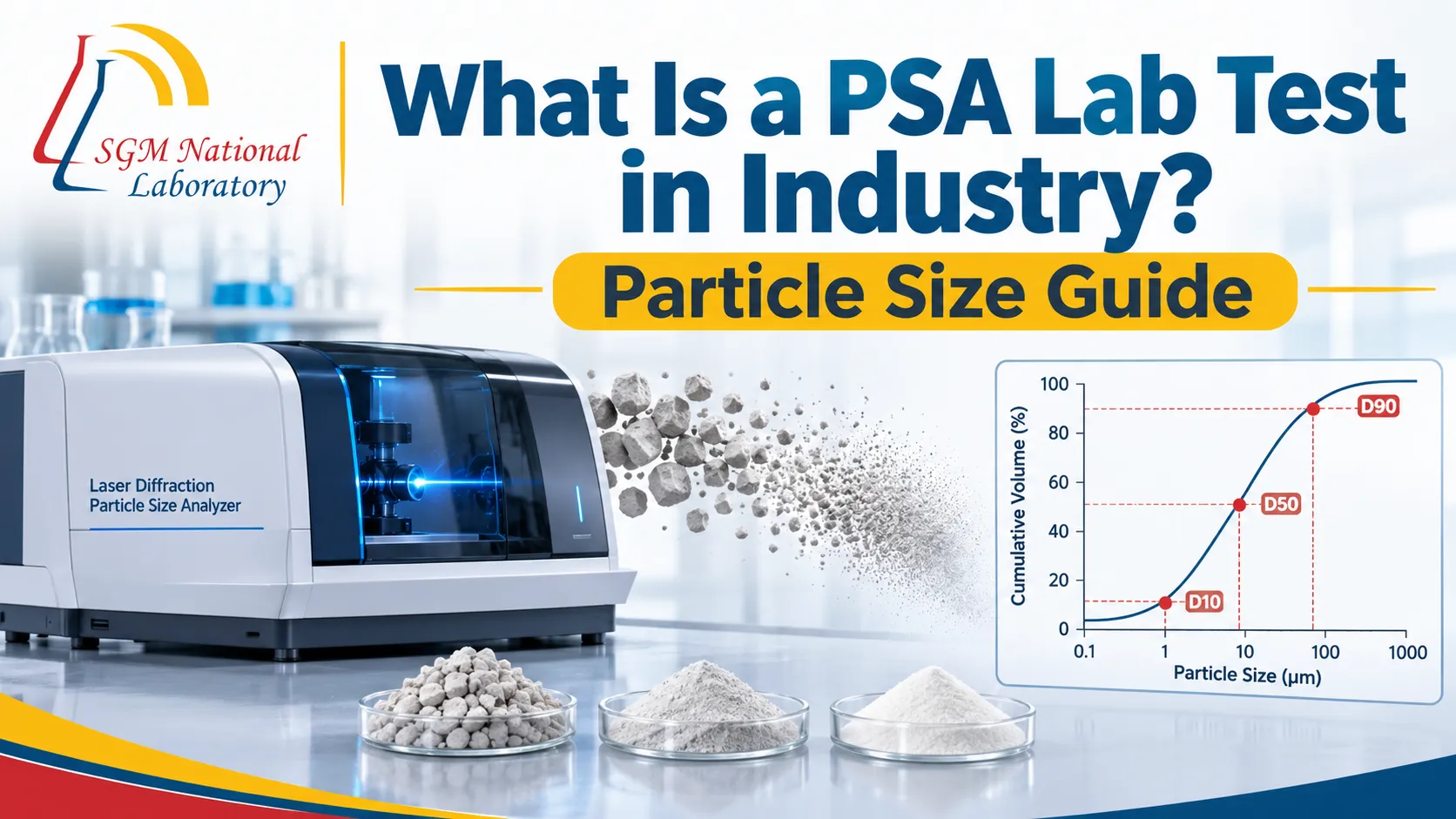
In industrial and material testing, PSA means particle size analysis, not the medical prostate test. A PSA lab test measures the size distribution of a powder or slurry, usually by laser diffraction, and reports D10, D50, D90, span and a distribution curve for quality control.
We get this question on the phone a lot. Someone from a paint unit or a mineral grinding plant calls and says, “Our buyer is asking for a PSA lab test report. What exactly is that?” Fair question. A PSA laboratory test isn’t something they teach you in a commerce degree, and most of what comes up online is about men’s health.
So here’s the plain version. What a PSA lab test is, what the report means, and when you actually need one. Jargon kept to a minimum.
What Does PSA Stand for in Material Testing?
PSA stands for Particle Size Analysis. Simple enough. A PSA lab test is just the lab work that measures it.
What it measures is a little more interesting. Grind any mineral, say calcite, and you don’t get one neat size. You get a spread. Some of it is almost dust, most of it sits in a middle band, and a few bigger grains always sneak through. A PSA lab test tells you how much of your powder falls into each size, measured in microns.
Why people search “PSA in lab test”
Because Google gets confused, and so do people. Type “PSA test” and you’ll get hospital pages. That’s why buyers and QC staff end up searching things like “PSA in lab test” or “PSA laboratory test” when they want the industrial meaning. If the request comes from a factory, a mine or a trading firm, they mean particle size. Every time.
Isn’t mesh size enough?
Honestly, for a lot of old-school trading, mesh was enough. “Give me 325 mesh” and everyone understood. The trouble is that mesh only tells you what passed through a screen. It says nothing about how fine the fine part is.
Two lots can both pass 325 mesh and still behave very differently in a customer’s process. Put them through a PSA laboratory test and you’ll see why. That’s usually where buyer-seller arguments get settled.
How Is a PSA Lab Test Done?
There’s more than one way to run a PSA lab test. Which one a lab picks depends on your material and how fine it is.
Laser diffraction
Most PSA testing today runs on laser diffraction. The powder is dispersed, a laser is passed through it, and the light scatters. Fine particles throw light out wide, coarse ones scatter it only a little. The instrument reads that pattern and works back to a size distribution. It covers a huge range, from under a micron to a few millimetres.
You can run a PSA lab test wet or dry. Wet (in water or another liquid) is better for fine minerals that like to stick together. Dry is used for things that shouldn’t touch water, cement being the usual example. Whichever is used, it should be written on your PSA laboratory test report. If it isn’t, ask.
Sieve analysis
The old method, and still a good one for coarse material like sand, granules or aggregates. You shake the sample through a stack of sieves and weigh what stays on each one. It just can’t see very fine particles well, so for micronised powders most buyers now want a laser PSA laboratory test instead.
Other options
Sedimentation, image analysis and dynamic light scattering are for special cases, like nano materials or jobs where shape matters. For everyday industrial powders, a laser PSA laboratory test does the job.
What Do PSA Lab Results Show?
This is where people’s eyes glaze over, and it’s why so many search for help reading a PSA in lab test report. The first time you see PSA lab results, it looks like a page of random numbers and a wavy graph. It’s less scary once you know which three or four lines to read.
D10, D50, D90
- D10 is the size that 10% of your particles are smaller than. Read it as your fines.
- D50 is the middle. Half the powder is finer, half is coarser. Most specs are written around this one.
- D90 is the size that 90% of particles are below. This is your coarse end.
If you only remember one thing, remember this: a good D50 can hide a bad D90. The median can look perfect while a few oversize grains are wrecking someone’s paint finish. Always check both in your PSA lab results.
Span and the curve
Span is (D90 minus D10) divided by D50. Lower span in your PSA lab results means a tighter powder. On the graph, one clean peak is what you want to see. Two humps usually mean two different materials got mixed, or the grinding wasn’t consistent. We’ve seen that more often than you’d think, especially when lots are blended at the godown.
Span and the curve
Below is the kind of PSA in lab test report you’d get for ground calcium carbonate. The numbers are an example, not a real client’s data, but the layout is typical.
| Parameter | Result |
|---|---|
| Sample | Calcium Carbonate Powder |
| Method | Laser Diffraction, Wet Dispersion (Water) |
| D10 | 1.8 µm |
| D50 | 6.4 µm |
| D90 | 18.7 µm |
| Span | 2.64 |
| % Below 2 µm | 11.2% |
| % Above 45 µm | 0.3% |
| Remarks | Single peak, no oversize seen |
A buyer in plastics or paint would look at these PSA lab results and be fairly happy. It’s fine, reasonably uniform, and there’s very little grit above 45 microns. That’s the whole point. You stop saying “the powder feels okay” and start writing actual numbers into the purchase order.
Which Materials Need PSA Testing?
More than you’d guess. If something gets ground, milled or blended into a powder, PSA testing probably matters for it somewhere down the line.
Minerals
Calcite, dolomite, quartz, feldspar, talc, barite, bentonite, china clay. All of these are sold by grade, and the grade is mostly about particle size. That’s why PSA testing is so common in the mineral trade. Udaipur and the rest of Rajasthan process a lot of these minerals, so for local grinders and exporters a PSA lab test before dispatch is pretty much routine now.
Paint, plastic and ceramics
Here size shows up as gloss, opacity and surface finish. In ceramics it changes how the body shrinks during firing, so many tile units run a PSA lab test on every new filler lot. A slightly coarse batch can mean specks on tiles, and nobody wants that phone call.
Pharma, food and chemicals
Particle size decides how quickly a tablet dissolves or how smoothly a food powder mixes in, and a PSA in lab test report is how you prove it. In these sectors it’s usually written into the spec, so a PSA laboratory test result is expected with each batch.
Cement, fly ash and construction
Fineness affects setting time and strength, so PSA testing is part of cement QC. Fly ash, slag and micro silica go through a PSA lab test too, especially when a project has strict mix design requirements.
How Long Does a PSA Test Take?
The instrument part of a PSA lab test is fast. A single laser run takes a few minutes. What takes time is everything around it.
Rough timeline
- The sample comes in and gets logged.
- It’s prepared and dispersed properly, which can take ten minutes or an hour depending on how stubborn the material is.
- It’s measured, usually more than once, so the result is repeatable.
- Someone checks the data and the report goes out.
In most cases PSA lab results are ready in 24 to 48 hours. A PSA laboratory test on a routine mineral can be quicker if you call ahead.
When it takes longer
Powders that float, clump, dissolve or react need a few method trials before PSA testing can start. Wet cakes and slurries may have to be dried. And if you want sieve data along with the laser PSA in lab test report, that’s an extra step. The best way to avoid delays is to tell the lab what the material is and what spec you’re testing against before you send it.
How to Get PSA Lab Results You Can Trust
A PSA lab test can only be as good as the sample you send. Sampling is the part people skip, and it’s where most “wrong” results actually come from.
Send a sample that represents the lot
Powder separates in the bag. Fines settle down, coarse stuff rides on top. If you scoop from the top of one bag, your PSA lab results describe the top of one bag. Take a little from different bags and different depths, mix it, and send around 50 to 100 grams for the PSA lab test.
Keep the method the same
Wet versus dry, or one instrument versus another, can shift the numbers a bit for the same powder. If you’re comparing suppliers or tracking batches over months, stick with one lab and one method for every PSA laboratory test. Otherwise you’ll end up chasing differences that come from the PSA in lab test setup, not from your material.
Tell the lab what you care about
Maybe your buyer only checks D50. Maybe it’s D97, or % below 2 microns, or a 45 micron residue. Say so when you book the PSA testing. A short report with the right numbers beats a long one nobody reads, and it makes PSA testing faster too.
Not sure which PSA in lab test method suits your powder? Our PSA laboratory team at SGM National Lab in Udaipur works with minerals, fillers and chemical powders regularly and can guide you before you send the sample.
Conclusion
A PSA lab test answers a question that sounds basic but costs real money when it’s ignored: how big are your particles, actually? Once you can read D10, D50, D90 and span, your PSA lab results stop looking like noise. They become something you can use to set specs, catch bad lots early and back up your quality when a buyer pushes back.
Regular PSA testing doesn’t cost much. Think of each PSA lab test as cheap insurance, especially next to one rejected truck. And the next time someone at your plant asks for a “PSA in lab test”, you’ll know they mean particle size, not a blood report.
Frequently Asked Questions
In materials and industrial testing, PSA stands for particle size analysis. In medicine PSA means prostate-specific antigen, a blood test that SGM does not offer.
It measures the size range of particles in a sample and reports values such as D10, D50, D90, mean size and span, with a distribution curve.
Mineral powders, cement, fly ash, pigments, fillers, fertilizers, ceramic raw materials and many other dry powders or slurries.
A report usually has a table of size bands, a cumulative curve and key D-values. Some reports also give specific surface area.
Send a representative sample in a sealed bag, mention whether it dissolves in water and say if you need wet or dry measurement.
At SGM the report usually takes 2 to 4 working days, depending on the number of samples.
Method, wet or dry dispersion, sample splitting and instrument settings can all change results, so share the earlier method when you compare reports.