
What Is a Fertilizer Testing Laboratory?
A fertilizer testing laboratory is a facility that analyzes fertilizer samples to measure their nutrient content and selected chemical or physical properties. Trained analysts use calibrated instruments and defined test methods to produce reliable data. Manufacturers, traders, and suppliers often choose an independent fertilizer testing lab in India because an outside party offers an unbiased view of product quality. The results can be compared with the product’s specification and used to support internal quality checks. A good fertilizer analysis laboratory helps you understand what is actually in your product, not just what the formulation sheet says.Why Is Fertilizer Testing Important for Quality Control?
Regular fertilizer testing services give businesses clear, measurable information. Here are the main benefits:- Nutrient verification: Testing checks whether measured nutrient levels meet the applicable product specification.
- Batch consistency: Results from different batches can be compared, which helps identify variations in production.
- Quality issue detection: Analysis can point out certain composition or physical-property concerns, such as high moisture or uneven particle size.
- Product reliability: Analytical data gives your quality team evidence to support decisions about release, rework, or further checks.
Which Parameters Are Tested in Fertilizer Analysis?
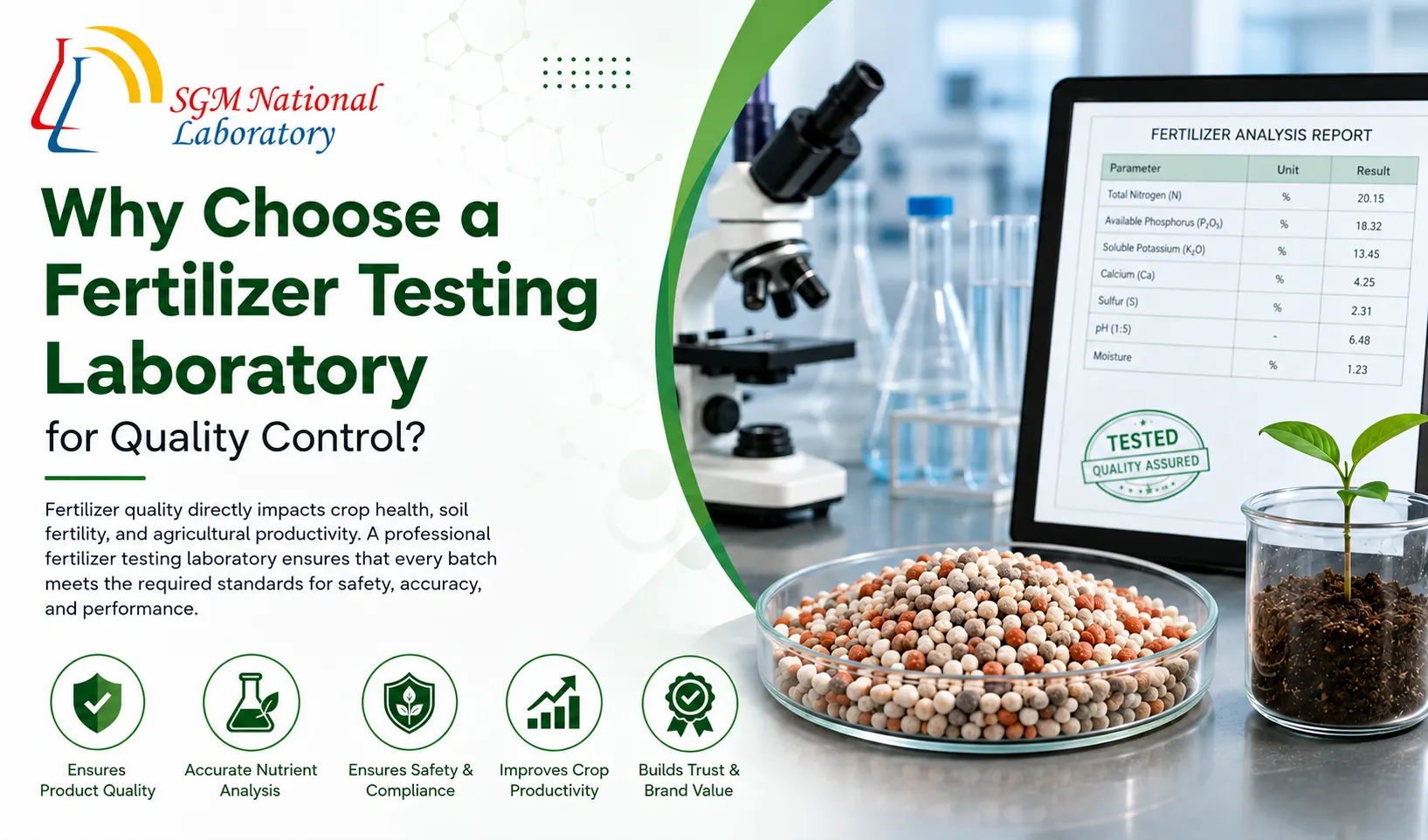
The parameters depend on the fertilizer type, its intended use, and the specification that applies. Common tests in fertilizer chemical analysis include:| Parameter | Why It Matters |
| Nitrogen, phosphorus, potassium (NPK) | Main plant nutrients; most labels are based on these values |
| Moisture content | Affects storage, handling, and nutrient concentration |
| pH and electrical conductivity (where relevant) | Indicate how the product may behave in soil or solution |
| Micronutrients (zinc, iron, boron) | Needed in small amounts for healthy crop growth |
| Physical properties (particle size, solubility) | Influence spreading, dissolving, and field performance |
How Does the Fertilizer Testing Process Work?
The process is simple when each step is followed carefully:- Identify requirements: Decide the fertilizer type and the parameters you need tested.
- Collect a representative sample: Use a proper sampling procedure so the sample reflects the whole lot, not just one corner of it.
- Prepare the sample: In sample preparation, the material is mixed, ground, or processed as the test method requires.
- Conduct laboratory analysis: Analysts apply suitable validated or standardized test methods.
- Review the results: Findings are compared with the applicable specification.
- Issue the laboratory report: The report lists the tested parameters and results.
How Testing Requirements Differ Across Fertilizer Types
Different fertilizer types need different analytical approaches, because their composition and use are not the same.- Chemical and NPK fertilizers: Focus is usually on primary nutrient content and moisture.
- Organic fertilizers and compost-based products: May need checks such as organic matter, moisture, and pH, depending on the specification.
- Water-soluble fertilizers: Solubility and conductivity are often important.
- Micronutrient and complex fertilizers: Require accurate measurement of several elements at lower concentrations.
What Should You Look for in a Fertilizer Testing Laboratory in India?
Before submitting samples, it helps to evaluate the laboratory. Consider these points:- Relevant testing capabilities and equipment for your product
- Qualified technical personnel
- Validated or standardized test methods
- Clear sample-handling procedures
- Detailed, easy-to-understand laboratory reports
- Verified accreditation and scope, where applicable
- Transparent communication about turnaround time and test requirements
Fertilizer Testing Services at SGM National Laboratory
SGM National Laboratory offers fertilizer testing services for manufacturers and suppliers who need reliable analysis. Before you submit a sample, you can discuss your fertilizer type, required parameters, and applicable specification with the team, so the testing plan fits your needs. For details on available tests, equipment, accreditations, and turnaround times, please contact the laboratory directly. If you are looking for a fertilizer testing lab in Rajasthan, you are welcome to enquire about your testing requirements.Conclusion
A fertilizer testing laboratory supports quality control by verifying nutrients, showing batch-to-batch consistency, and giving your team data for informed decisions. The right laboratory is not just the nearest or cheapest one. Choose a partner with relevant capabilities, suitable test methods, and clear, transparent reporting. That way, your fertilizer quality testing results are something you can trust and act on.- What is a fertilizer testing laboratory? A fertilizer testing laboratory analyzes fertilizer samples to measure nutrient content and selected chemical or physical properties. Trained analysts use defined test methods, and the results help businesses check product quality against specifications.
- Why is fertilizer quality testing important? Testing confirms whether a product contains the nutrients it claims. It also helps spot differences between batches and possible quality issues early, so manufacturers and suppliers can make better quality-control decisions before products reach farmers.
- Which parameters are tested in fertilizer chemical analysis? Common tests include nitrogen, phosphorus and potassium (NPK), moisture, pH, electrical conductivity, and micronutrients like zinc, iron and boron. The exact list depends on the fertilizer type, its intended use, and the applicable specification.
- Do all fertilizers need the same tests? No. Chemical NPK fertilizers, organic fertilizers, water-soluble products, and micronutrient mixes each need different parameters and methods. It is best to confirm the product category and specification with the laboratory before sending a sample.
- How should I collect a sample for testing? Take a representative sample that reflects the whole batch, not just one bag or spot. Use clean, dry containers, label them clearly, and avoid contamination. Ask the laboratory for its sampling and quantity requirements before dispatch.
- What happens during sample preparation? The sample is mixed, ground, or otherwise processed so the small portion tested represents the full sample. The method depends on the fertilizer type and the test being done, and careful preparation helps keep results accurate.
- What is included in a laboratory report? A laboratory report lists the tested parameters, the results, and the sample details. It lets you compare findings with the applicable specification. Ask the laboratory about the report format and what information it includes.
- How do I choose a fertilizer testing laboratory in India? Check its testing capabilities, equipment, qualified staff, test methods, and sample-handling procedures. Verify any accreditation and confirm that your required tests fall within its scope. Clear communication on turnaround time also matters.
- Why choose a fertilizer testing lab in Rajasthan? A nearby laboratory can make sample transport simpler and may reduce delays for businesses in the region. Location is only one factor, though. Capability, suitable methods, and transparent reporting should always come first.
- How can I get fertilizer testing services at SGM National Laboratory? Contact the SGM National Laboratory team to discuss your fertilizer type, required parameters, and applicable specification. They can guide you on sample requirements, available tests, and turnaround times before you submit your sample.