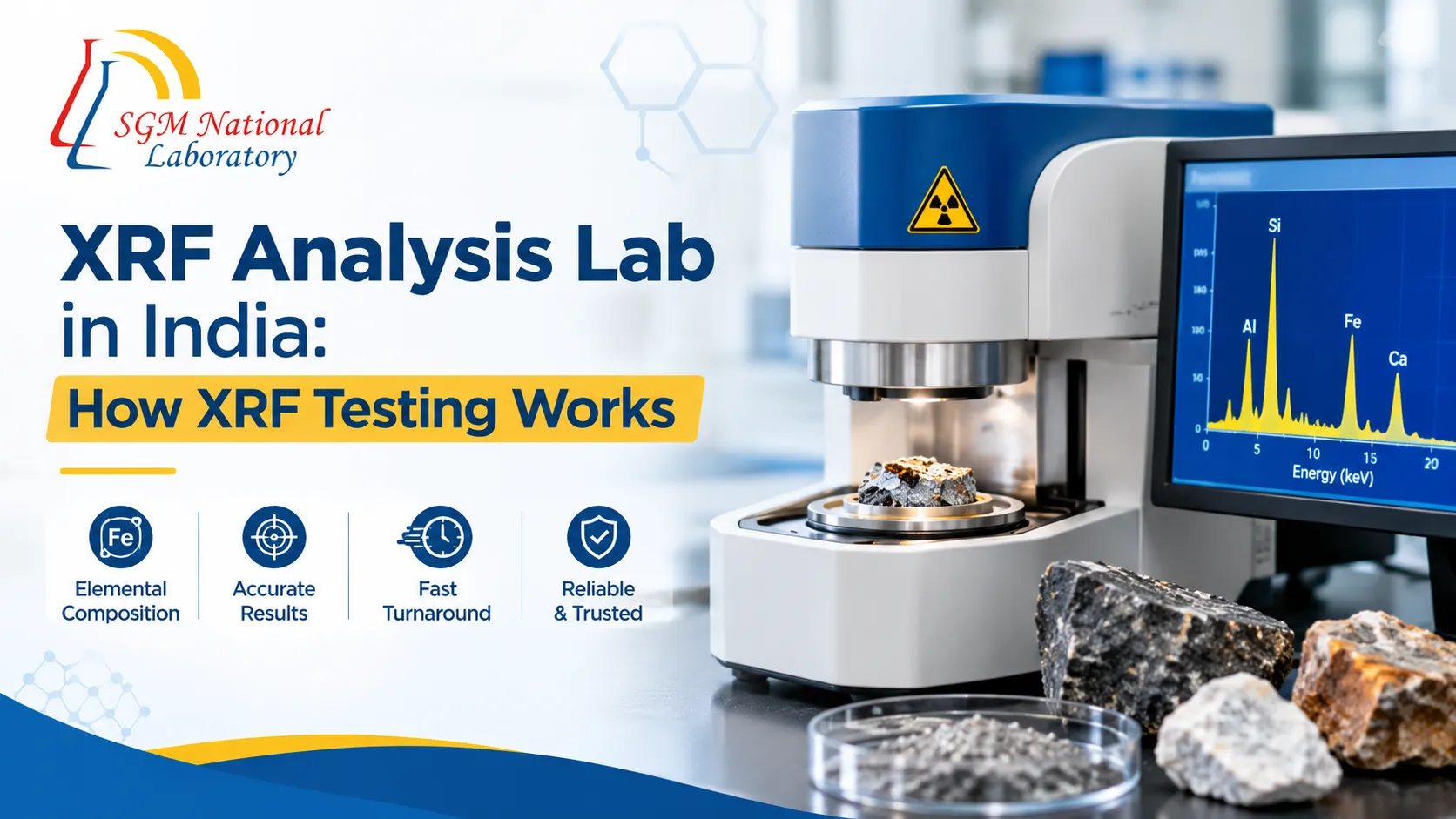
Ask anyone who runs a foundry or a cement plant what they hate most, and “waiting for a result” will be near the top. You’ve got material sitting there. Production is paused or, worse, running on a guess. That’s the main reason people turn to an XRF analysis lab in India: it gives a composition answer quickly, without destroying the sample.
If you’ve heard the term but never quite understood what happens when a sample goes in, this post covers it. No heavy physics, just what you actually need to know.
So, What Is XRF?
XRF is short for X-ray fluorescence. The name sounds intimidating, but the idea is simple. You hit a material with X-rays. The atoms in it get excited and respond by sending out X-rays of their own. Each element responds at its own particular energy, a bit like how every instrument in an orchestra has its own pitch. The machine listens, works out which “notes” it’s hearing, and measures how loud each one is.
Loudness tells you quantity. Pitch tells you which element. That’s really the whole trick.
What makes it so useful in practice is that nothing gets used up. No acid, no furnace, no cutting a piece off your finished part. For a lot of materials you get your sample back exactly as it arrived.
A Closer Look at What Happens Inside
Inside the analyser, an X-ray tube produces a beam that lands on your sample. That beam has enough energy to knock an electron out of an atom’s inner shell. The atom doesn’t like having that hole, so an electron from a higher shell drops down to fill it. When it drops, it gives off a little energy as an X-ray. That’s the fluorescence.
A detector picks up these X-rays, sorts them by energy and counts them. Software then compares the pattern with calibration data and turns it into numbers: percent for the main elements, parts per million for the small ones. A whole analysis can take a few minutes, and the result covers many elements together.
An
XRF analysis lab in India uses this principle to identify elements and estimate their concentrations in different materials, including ores, metals, cement and industrial powders.
Not All XRF Machines Are the Same
People often assume “XRF is XRF”. It isn’t. The type of instrument changes what you can trust the result for.
| Type |
What it’s like |
Where it’s used |
| EDXRF |
Sorts X-rays by energy; fast and flexible |
General lab work on metals, minerals, plastics |
| WDXRF |
Uses a crystal to separate wavelengths; sharper and more precise |
Cement, ores, tougher accuracy needs |
| Handheld |
A portable gun-style analyzer |
Scrap yards, shop floors, quick checks |
I’d put it this way. A handheld tells you what you’re looking at. A lab instrument tells you how much, and tells you with documentation behind it. If a number is going into a contract, a certificate or an export file, the lab route is safer.
What Happens to Your Sample at the Lab
Most people imagine you drop the sample in and a number comes out. In reality, preparation is where the quality is decided.
If you’ve sent a metal piece, the analyst will usually clean the surface or grind it flat. Paint, rust and oil sit on the outside, and the beam only reaches a shallow depth, so surface junk can easily throw off the reading. If you’ve sent a powder, such as cement, soil or crushed ore, it gets ground very fine and either pressed into a pellet or fused into a small glass disc. Fusion takes a bit longer but removes problems caused by grain size and mineral structure, so it’s often chosen when precision matters.
Liquids go into small sealed cups with a thin film on the bottom. Then comes the measurement. Good labs also run a known reference sample alongside yours to confirm the machine is reading correctly that day. Only then is the report written.
A reliable
chemical analysis laboratory follows suitable sample preparation and quality-control procedures to help ensure that the results accurately represent the material being tested.
If something goes wrong, it’s far more often in preparation than in the instrument.
What Can Be Tested?
A decent range. Typical samples include stainless steel and other alloys, aluminium, brass, bronze and nickel grades, plus precious metals like gold and silver. Mining and mineral clients send iron ore, bauxite, limestone and chromite. Cement plants send raw meal, clinker, fly ash and slag. Others send plastics for screening of restricted elements, soil and waste for heavy metal checks, or plated and coated parts.
An
XRF analysis lab in India may also analyse industrial powders, mineral samples and metal alloys, depending on the equipment, sample preparation and testing requirements.
If your material isn’t mentioned here, ask anyway. A lot of unusual samples can still be analysed with the right preparation.
Who Actually Uses It?
Steel and casting units use XRF to confirm incoming material before it gets mixed into production, because one wrong grade can ruin a whole heat. Miners use it to judge ore quality and decide how to blend. Cement manufacturers watch their chemistry closely, since small shifts change how the final product behaves. Exporters and electronics suppliers use it to screen for elements like lead or cadmium that some markets restrict. Recyclers sort alloys with it, and that has a direct effect on what they get paid. Environmental consultants use it to check soil for heavy metals. Jewellers use it to confirm purity without damaging a piece.
Different industries, same need: a quick, believable answer.
The Honest Pros and Cons
XRF is good, but it’s not magic.
On the plus side, it’s non-destructive, quick, handles many elements in one go and generally costs less per sample than wet chemical methods. It also covers a wide range, from main components down to trace amounts.
On the other side, standard XRF can’t see the very lightest elements such as hydrogen, lithium and boron. It tells you which elements are present but not what compounds they form or what oxidation state they’re in. Surface condition matters a lot. Accuracy depends on proper calibration with standards close to your sample type. And when you need extremely low trace levels, techniques like ICP-MS usually do a better job.
Knowing these limits is what separates a sensible user from a disappointed one.
Mistakes I’d Warn Any Client About
The first is sending a coated or dirty sample without saying so. The reading will describe the coating, not the metal beneath. Tell the lab what’s on the surface.
The second is sending a sample that doesn’t represent the batch. One small chip from the corner of a large lot can tell you very little about the rest. For powders and ores in particular, mix well and send a proper portion.
The third is expecting one test to answer every question. If you need to know about a specific compound, or you’re chasing very low trace levels, XRF may only be the first step.
XRF Is One Tool Among Many
In a proper
chemical testing lab in India, XRF sits alongside other techniques rather than replacing them. Optical emission spectroscopy gives precise chemistry for metals, including carbon.
ICP-OES and ICP-MS reach very low detection limits. Atomic absorption, titration and wet chemistry handle assays and specific compounds. FTIR, GC and HPLC take care of organic and polymer work.
A common pattern is to use XRF for a fast first look and then confirm the important results with a second method. That layered approach is what a good
chemical analysis laboratory should be able to offer: fast answers where speed helps, careful confirmation where the stakes are higher.
An
XRF analysis lab in India can help businesses select a suitable elemental testing method based on the material, required accuracy and reporting needs.
How to Pick a Lab You Can Rely On
Start with accreditation. Ask whether the lab is NABL accredited under ISO/IEC 17025, and, importantly, whether the specific test you want falls inside its scope. Accreditation for one test doesn’t automatically cover another.
Then ask about equipment and preparation. Does the lab do pelletising, fusion and polishing in-house? Which standards and reference materials does it use? Can it explain the method behind your result? Also look at practical things: how clear the report is, how long it takes, and whether you can actually speak to an analyst when something looks odd. That last point matters more than most people expect.
When choosing an
XRF analysis lab in India, also check whether the laboratory can test your specific sample type and provide a report suited to your application.
Before selecting a
chemical testing lab in India, confirm that it has the appropriate testing capabilities, quality-control procedures and experience with your material.
A reliable
chemical analysis laboratory should also be able to explain the test method, its limitations and whether additional analysis is required.
Final Word
XRF has lasted in industry because it solves a real problem: finding out what a material contains, quickly, without wrecking it. Once you understand the steps, from preparation through measurement to reporting, you’ll send better samples and ask better questions.
If you’ve got material that needs elemental analysis, send us the sample details and what you want to find out. We’ll suggest the right method, give a realistic timeline and share a report you can actually use.
SGM National Laboratory provides testing support for a range of industrial materials. Contact us to discuss your sample requirements and find out whether XRF or another analytical method is suitable for your testing needs.
Quick Questions People Ask
What is XRF analysis?
X-ray fluorescence excites a sample with X-rays and reads the characteristic energy each element gives off, which reveals the composition.
What samples can be tested by XRF?
Powders, pressed pellets, fused beads, solids and some liquids, such as ores, cement raw materials, ceramics, metals and soils.
Is XRF a destructive test?
For solids it is generally non-destructive, though powders are usually ground and pressed, and fusion methods change the sample form.
What are the limits of XRF?
Very light elements are hard to measure and results depend on sample preparation. Elements such as carbon usually need other methods.
How accurate is XRF?
With proper calibration and sample preparation, XRF is precise for major and minor elements. Trace-level work may need other techniques such as ICP.
When should I use wet chemical analysis instead?
Use it for specific constituents, for moisture, or when a result needs verification. Labs often combine XRF with wet chemistry.
What details should I give the lab?
Share the material, expected elements, the reporting format (elements or oxides) and the purpose, such as a grade check or a contract dispute.